Friendly customer service and expert in their field recommend everybody who is looking best finished product and joyful experience.
AI Search Strategy: A 90-Day Plan for Australian Businesses
Most Australian business owners have noticed the same thing over the past year: customers are asking ChatGPT or Google’s AI Overviews before they ever open a search results page. Roy Morgan’s most recent research puts it in hard numbers — 13.6 million Australians, or 58% of everyone aged 14 and over, now use an AI tool in an average four-week period, with ChatGPT alone reaching 10.5 million Australians. That is more than half the country asking an AI a question before a human answers it.
The businesses that show up in those answers get chosen. The businesses that don’t, disappear from the conversation entirely, no matter how good their website looks.
This guide lays out a 90-day AI search strategy for Australian businesses — a geo 90-day plan built on generative engine optimisation (GEO) principles, not a theory piece, a working plan you can start on Monday.
What is An AI Search Strategy?
An AI search strategy is a structured plan to make a business’s content discoverable, trustworthy and citable inside AI-generated responses from tools like ChatGPT, Google AI Overviews, Gemini and Perplexity, rather than only ranking in a traditional list of blue links. This discipline is often called generative engine optimisation, or GEO, and generative engine optimisation in Australia is still a young enough field that most local businesses have no strategy for it at all.
Traditional search engines chase a position on a results page. An AI search strategy chases something narrower and harder: being one of the handful of cited sources an AI engine trusts enough to name in its response. A geo strategy overlaps with SEO fundamentals, but the target is different, and so is the plan needed to hit it.
Why Australian Businesses Can’t Wait to Start
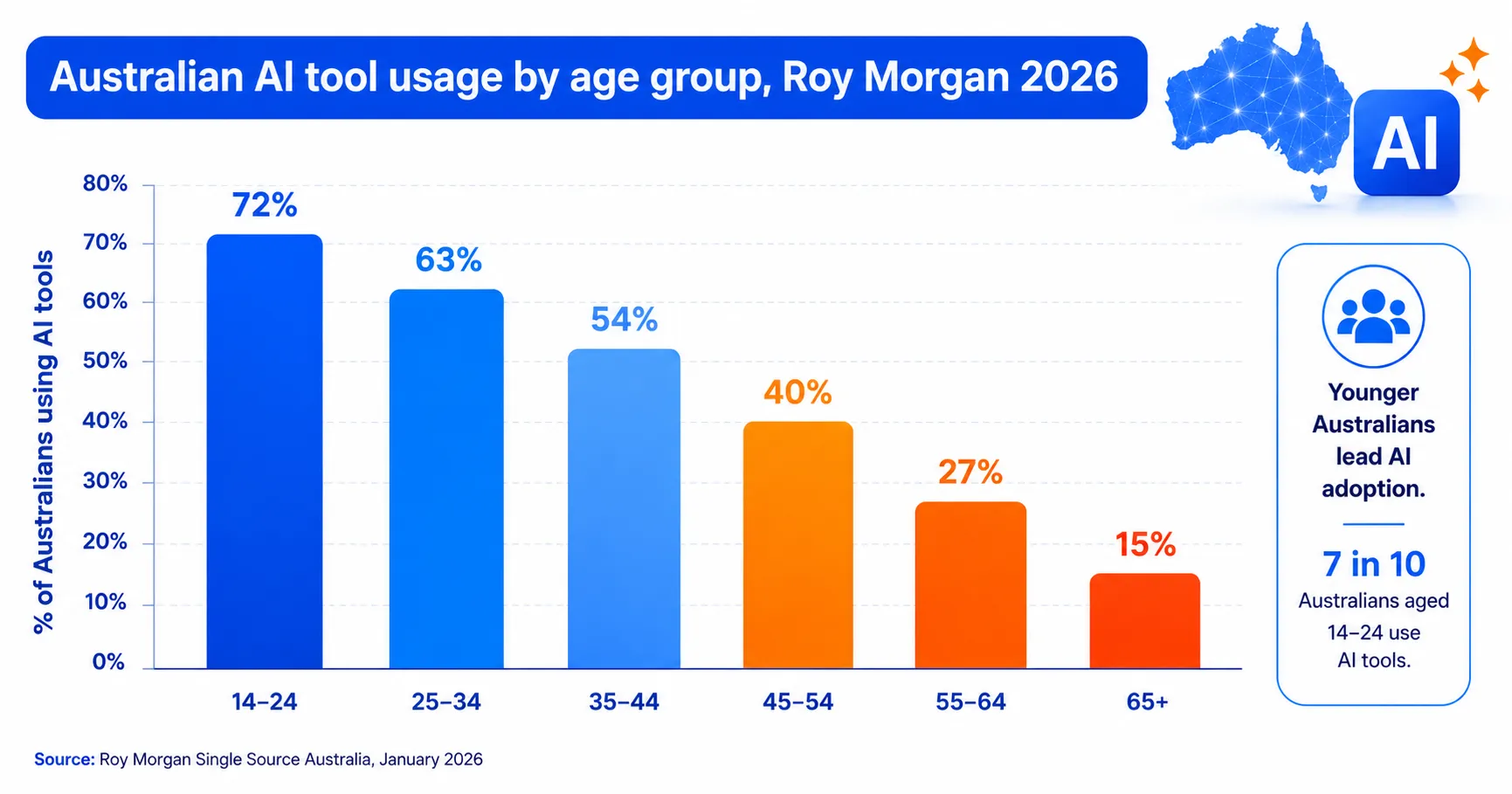
Australia is not a slow-moving market on this front. Adoption here already tracks close to the world’s most AI-engaged countries, and Australians aged 25 to 49 are the heaviest users of all, with 74% of 25-34 year olds and 72% of 35-49 year olds using an AI tool regularly, according to Roy Morgan. Those are prime buying-age Australians, putting search queries about tradies, clinics, accountants and retailers straight into AI search engines rather than a search box, and AI Overviews Australia has become one of the fastest-growing ways Australians run those queries without leaving Google at all.
The gap between businesses that show up in those responses and businesses that don’t is widening every month, and it compounds. The AI models behind ChatGPT, Gemini and AI Overviews that cite a business today are more likely to cite it again next month, because trust signals build on themselves. Waiting six months to start does not mean starting from the same place later — it means starting further behind.
The 90-day Plan, Week by Week
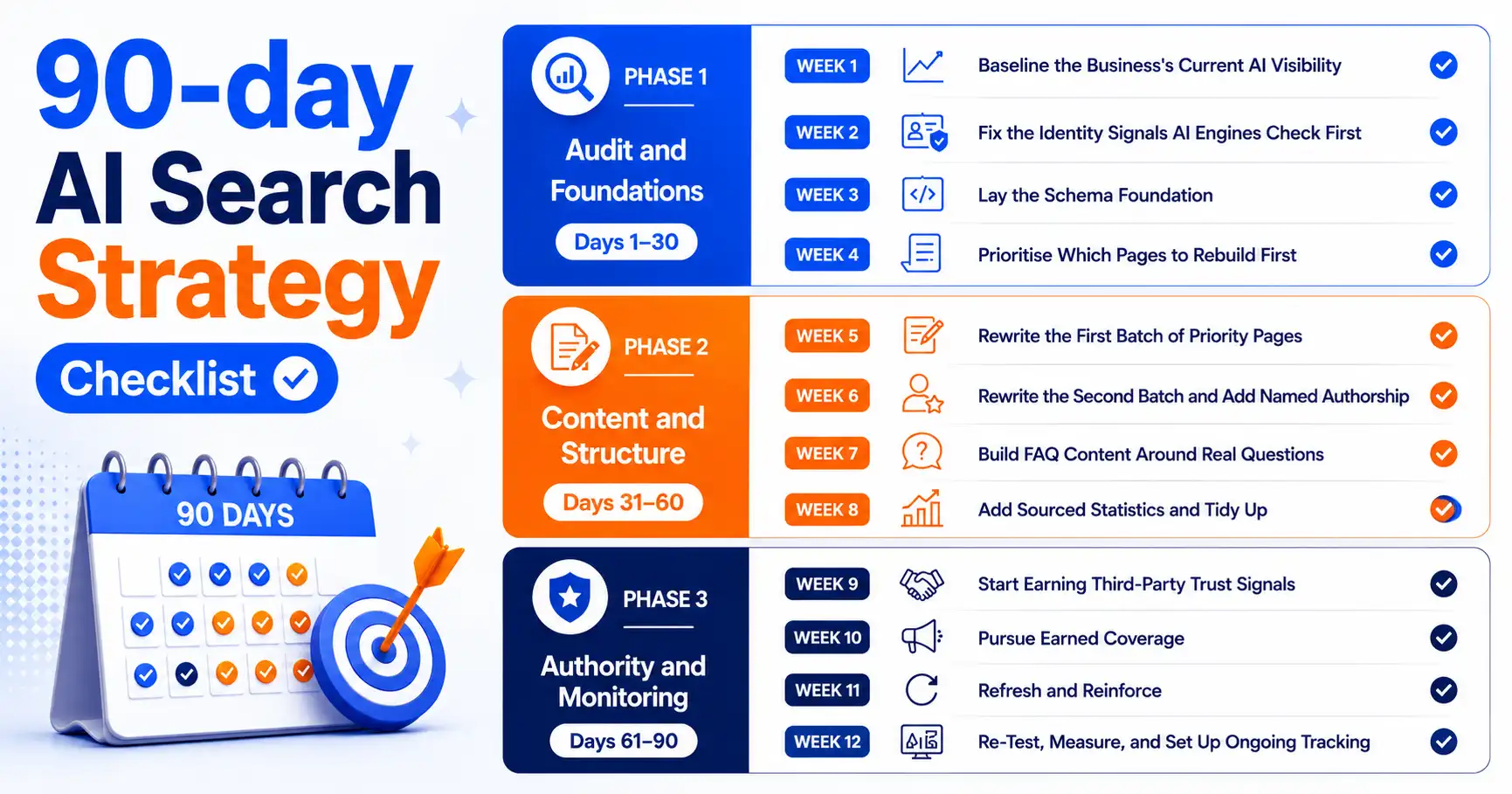
Phase 1 (Days 1-30): Audit and Foundations
The first month is about finding out where a business actually stands, not guessing, and fixing the basics an AI engine checks before it will ever consider citing a page.
Week 1: Baseline the Business’s Current AI Visibility
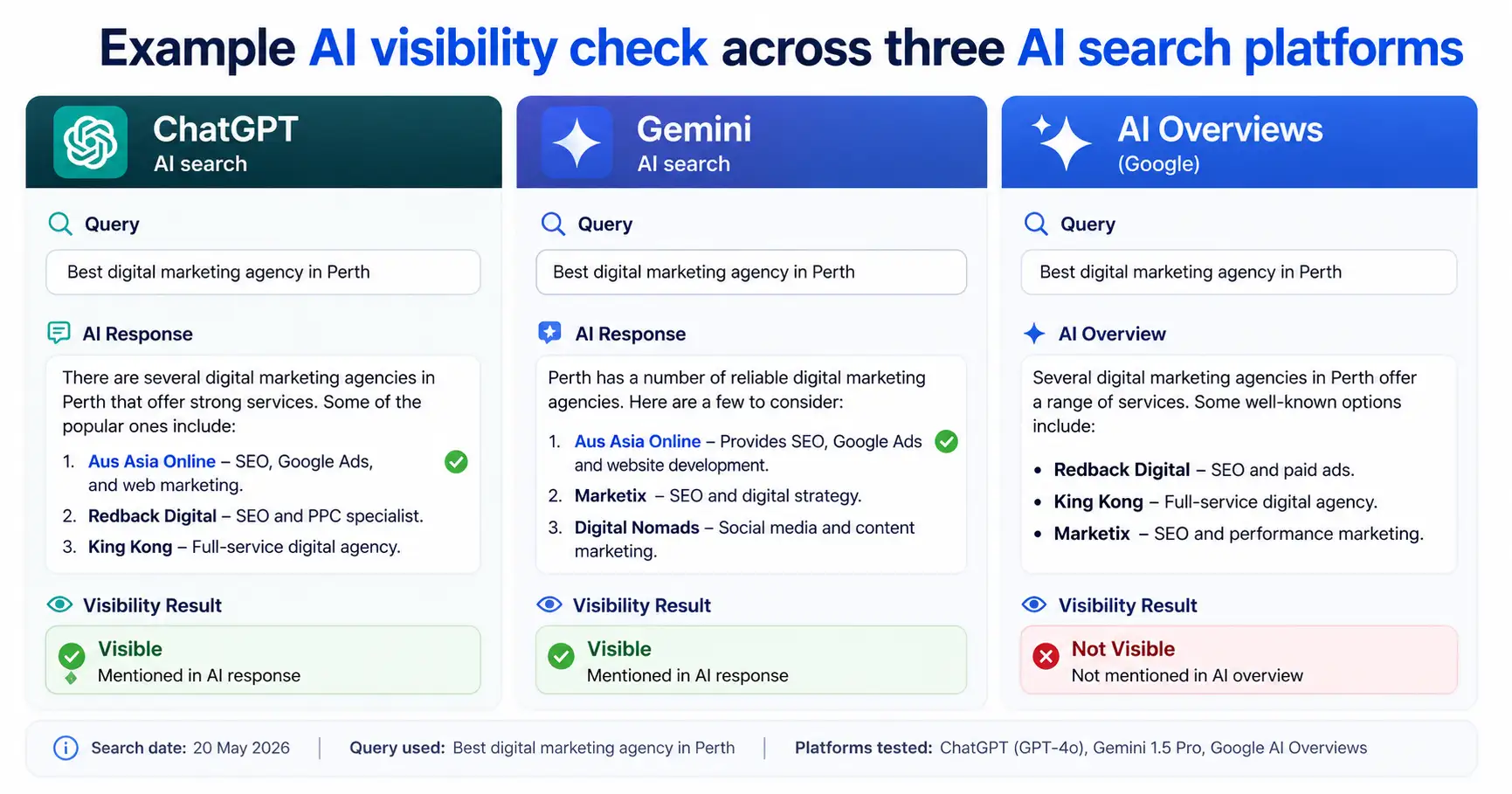
Write a list of 15-20 real questions customers would ask an AI assistant — mix broad (“best [service] in [city]”) and specific (“who does emergency [service] in [suburb]”) phrasing. Run every question through ChatGPT, Gemini, Google AI Overviews and Perplexity. Record, in a simple spreadsheet, whether the business is mentioned, listed among the cited sources, or absent. Note which competitors are appearing instead, and which of their pages are being cited. Screenshot results as a dated baseline — this is what week 12’s tracking gets compared against.
Week 2: Fix the Identity Signals AI Engines Check First
Audit business name, address and phone number (NAP) across the website, Google Business Profile, Facebook, and any directories or supplier listings — correct every mismatch. Confirm the Google Business Profile category, service areas and business hours are accurate and complete. Check robots.txt for GPTBot, Google-Extended, ClaudeBot, PerplexityBot and OAI-SearchBot — remove any blocks unless there’s a deliberate reason to keep them. Confirm key pages render as static, readable HTML rather than requiring JavaScript to load the core content.
Week 3: Lay the Schema Foundation
Add Organisation schema markup to the homepage with correct legal name, logo, and contact details. Add LocalBusiness schema (or the relevant sub-type) with service area, opening hours and geo-coordinates. Add Author schema to any page with a named contributor, linking to a bio page. Structured data gives AI models a machine-readable summary of who the business is, rather than making them guess from unstructured text — see Google’s own guidance on AI features and your website for the technical details. Validate every schema block with Google’s Rich Results Test and fix any errors before moving on.
Week 4: Prioritise Which Pages to Rebuild First
Rank existing pages by commercial value and current AI visibility gap — start with high-value pages that scored worst in week 1’s test. Shortlist the top 5-8 pages to rewrite in the next phase (usually core service pages, an about/team page, and one or two high-intent guides). Draft a one-page brief per priority page: the exact customer question it should answer, the statistic to include, and who the named author will be.
By day 30, a business should know exactly where it is invisible and have the technical groundwork laid to fix it.
Phase 2 (Days 31–60): Content and Structure
The second month is about giving AI engines something worth citing — pages that answer clearly, name a real author, and back claims with sourced detail.
Week 5: Rewrite the First Batch of Priority Pages
Rewrite the opening two to three sentences of each main section to directly answer the question before adding context. Break long paragraphs into two-to-three sentence blocks so AI engines can extract clean passages. Replace vague claims (“we’re experts in X”) with specific detail (how long, how many jobs, what method, what result).
Week 6: Rewrite the Second Batch and Add Named Authorship
Complete rewrites on the remaining priority pages from the week 4 shortlist. Add a named author with a short, real bio and relevant credentials or trade licence detail to each page. This is the same E-E-A-T principle Google has used for years, now applied to E-E-A-T for AI search. Insert one genuine first-hand example per page — a real job, a real client scenario, a specific result — not a generic claim.
Week 7: Build FAQ Content Around Real Questions
Turn the 15-20 questions from week 1 into FAQ blocks on the pages they’re most relevant to. Write each answer to stand alone in two to four sentences before adding further detail — this matches how people phrase questions to an AI assistant. Mark up every FAQ block with FAQPage schema and validate it.
Week 8: Add Sourced Statistics and Tidy Up
Add one specific, dated, named-source statistic to each priority page (industry figures, ABS data, or Roy Morgan-style adoption stats where relevant). Content with a named, dated statistic gets extracted and quoted far more often than unsupported opinion. Add a visible “last updated” date to every rewritten page. Do a final proofread pass and re-check all schema across the rewritten pages.
By day 60, the core service and information pages should read as clean, extractable, well-sourced answers rather than marketing copy.
Phase 3 (Days 61–90): Authority and Monitoring
The final month is about proving the business is trusted beyond its own website, and setting up a way to track whether the first two months are actually working.
Week 9: Start Earning Third-Party Trust Signals
Set up or claim a profile on one recognised review platform if the business doesn’t already have one (Google Reviews at a minimum, plus an industry-specific platform where relevant). Email or text the last 10-15 happy customers asking for a short review, with a direct link. Identify two to three local directories, industry associations or supplier partner pages the business should be listed on, and submit or update those listings — every one of these is a brand mention that helps a business get cited by ChatGPT and other AI search engines.
Week 10: Pursue Earned Coverage
Pitch one local news outlet, community Facebook group or industry publication with a genuinely useful angle (a seasonal tip, a local statistic, a case study) — not a sales pitch. Reach out to one supplier, industry body or complementary local business about a guest mention, co-authored piece or cross-link. More brand mentions across independent sites build the third-party trust signal AI models rely on most. Keep the review requests going — aim for a steady trickle rather than a one-off burst. Even a modest number of genuine reviews on a recognised platform can lift AI citation rates significantly compared with having none at all.
Week 11: Refresh and Reinforce
Revisit every rewritten page and update any figures, seasonal references or availability details so nothing reads as stale — AI engines lean toward recently updated sources. Check that new reviews and any earned mentions are reflected on the website (a testimonials section, a “featured in” line, etc.). Re-run the schema validator across the whole site to catch anything broken during the month’s edits.
Week 12: Re-Test, Measure, and Set Up Ongoing Tracking
Re-run the exact same 15-20 search queries from week 1 through ChatGPT, Gemini, AI Overviews and Perplexity, and compare directly against the baseline screenshots. Log which pages are now among the cited sources, which questions still return competitors, and which search visibility gaps remain. Set a recurring monthly calendar reminder to repeat this test, and note which content formats and topics produced the strongest citation gains — this becomes the template for months four onward.
By day 90, a business should have at least a handful of confirmed citations, a repeatable content process, and a monitoring habit that catches problems before they compound.
What This Looks Like for a Typical Australian Small Business
A Sydney plumber, a Melbourne accounting firm and a Brisbane physiotherapy clinic will all run this same 90-day shape, but the specifics differ. The plumber needs strong local entity signals and suburb-specific pages. The accounting firm sits in YMYL territory and needs a named, qualified author on every piece of financial guidance. The clinic needs both — named practitioner credentials and clear local service areas. The framework doesn’t change. What changes is which signal gets the most attention first.
Frequently Asked Questions
What is an AI search strategy?
An AI search strategy is a structured plan to make a business’s content discoverable, trustworthy and citable inside AI-generated answers from tools like ChatGPT, Google AI Overviews, Gemini and Perplexity, rather than relying only on traditional search results ranking.
How many Australians use AI tools like ChatGPT?
Roy Morgan’s early-2026 research found 13.6 million Australians, or 58% of people aged 14 and over, use an AI tool such as ChatGPT, Gemini, Copilot, Canva Magic Studio or Claude in an average four-week period, with ChatGPT the most widely used at 10.5 million Australians.
How long does it take to get cited by AI?
Most businesses following a structured plan start seeing early citation movement within four to eight weeks of fixing technical foundations and publishing better-structured content, with stronger, more consistent citations building over the full 90 days and beyond as third-party trust signals accumulate.
Do I need a big marketing team to run a 90-day AI search plan?
No. The plan is designed in three manageable phases, and most of the work — fixing NAP details, adding schema markup, rewriting key pages, requesting reviews — can be done by a small business owner or a single marketing person, though an agency can compress the timeline.
Does AI search replace SEO for Australian businesses?
No. Generative engine optimisation (GEO) builds on the same foundations as SEO — clean structured data, credible content, authoritative signals — but targets a different outcome: appearing among the cited sources inside an AI-generated response rather than only ranking in a list of links on traditional search engines. The two now need to run together.
Ready to Build Your 90-Day AI Search Strategy?
Improve your visibility across AI search platforms to attract more Australian customers.
Get Your AI Search Strategy
Build your AI search strategy
AI search is not a future trend for Australian businesses to plan around eventually — 58% of the country is already asking AI search engines questions a business could be answering. Aus Asia Online’s AI SEO agency helps Australian businesses run this exact geo 90-day plan, from the first AI search visibility audit through to ongoing citation tracking. Book a free AI search strategy session and we’ll show you exactly where the gaps are and what to fix first.

Book a Free Strategy Session
1 business day response
100% confidential
No obligation
Client praise
Loved by clients across every industry
Your feedback is incredibly important to us. Explore testimonials from our valued clients — their words shape how we build every campaign.
See More Reviews
Trusted partners
We proudly work with different industries of all sizes
Client success is always a priority for us. We deliver high-quality solutions tailored specifically to our clients' needs — helping them achieve their goals across every industry.
NDIS & Disability
Dental
Chiropractic
Physiotherapy
Legal
Real Estate
Hospitality
Restaurants
Fitness
Trades & Building
eCommerce & Retail
Automotive
Tourism & Travel
Education
Some of our happy clients


We're ready to listen...
Leave your details below or call us on 1300 189 687 and let's chat about your business, your goals, and how we can help you grow. No obligation. No cost.