Friendly customer service and expert in their field recommend everybody who is looking best finished product and joyful experience.
AI Search vs Traditional Search: What Australian Businesses Need to Know
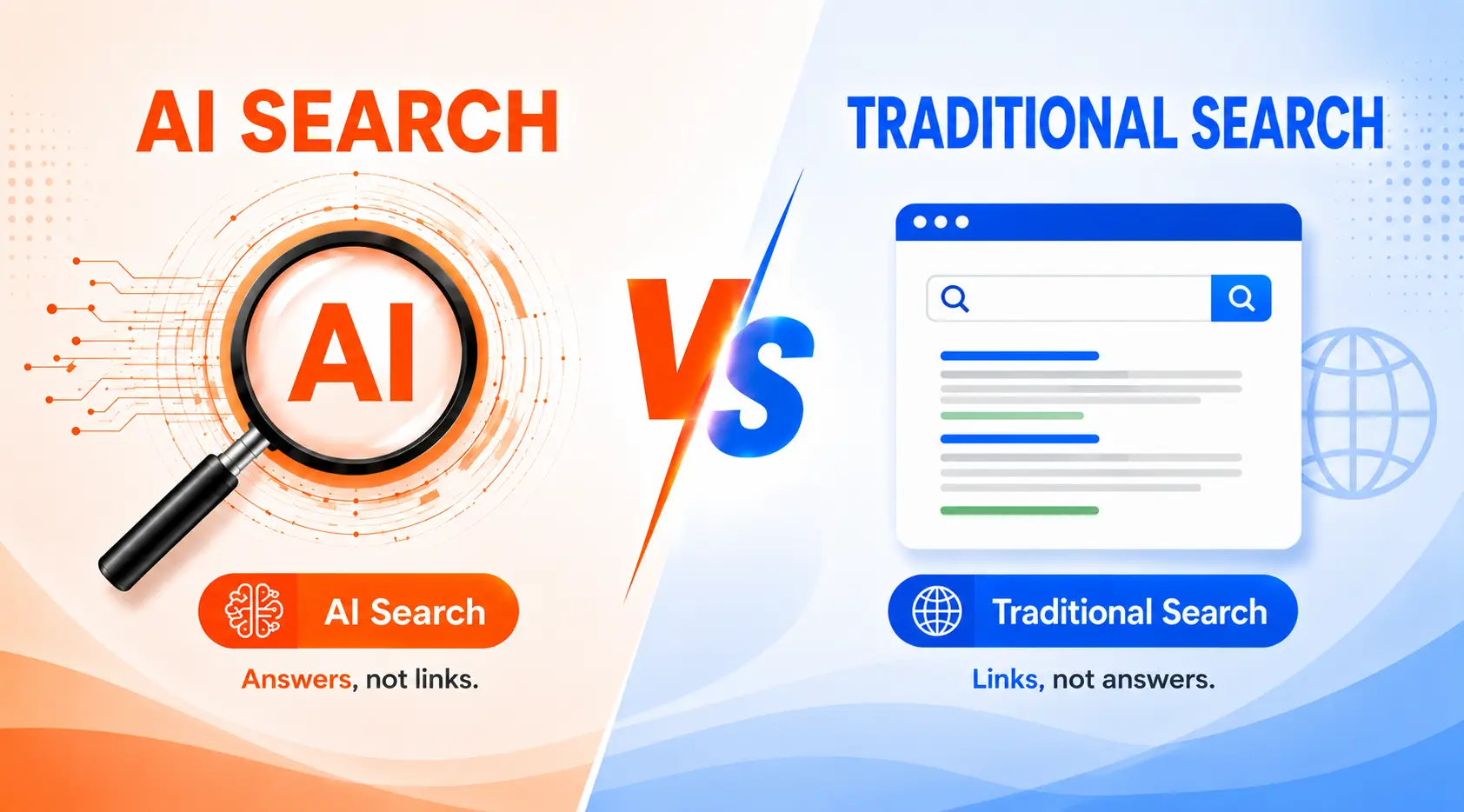
AI search vs traditional search is not a battle where one channel wins and the other disappears. Australian businesses now need to understand how both work together.
Traditional search still helps people find websites, compare services, check reviews and take action. AI search now helps people ask longer user questions, get faster answers and shortlist options before they click. That means your business can lose trust before someone even lands on your site.
The key shift is simple. Search visibility no longer starts with the click. It starts with the answer.
What Is Traditional Search?
Traditional search gives users a list of results after they type search queries into Google, Bing or another search engine.
A person might search for “accountant near me”, “best dentist in Kings Langley” or “commercial air conditioning installation cost Sydney”. The search engine then shows a mix of organic results, paid ads, maps, reviews, featured snippets, videos and related questions.
These search engine results pages let users compare options for themselves. They can open a few web pages, read reviews, check locations, look at pricing and decide who feels credible.
For Australian businesses, traditional search still matters because many customers use Google when they want to buy, call, book or visit. Strong SEO services help businesses improve these rankings, attract relevant traffic and turn search visibility into real enquiries.
What Is AI Search?
AI search gives users a generated response instead of only showing a list of links.
Tools like ChatGPT, Perplexity, Gemini and Google AI Overviews can summarise information, compare options and answer follow-up questions. A user can ask, “What should I look for before hiring a tax accountant in Western Sydney?” and get a clear AI generated summary without opening several websites first.
AI search does not only match keywords. It tries to understand meaning, context and intent. It may pull information from websites, business profiles, reviews, forums, articles, product pages and public data.
Generative AI tools use AI models to interpret the question, assess available sources and generate responses that feel more conversational than a normal search result.
Google’s own search updates show how AI features now sit closer to everyday search behaviour. You can learn more about these changes through the Google AI features in Search updates.
That creates a new challenge. Your website might rank well in Google, but AI tools may still ignore your brand if your content lacks clarity, proof or structure.
AI Search vs Traditional Search: The Main Difference
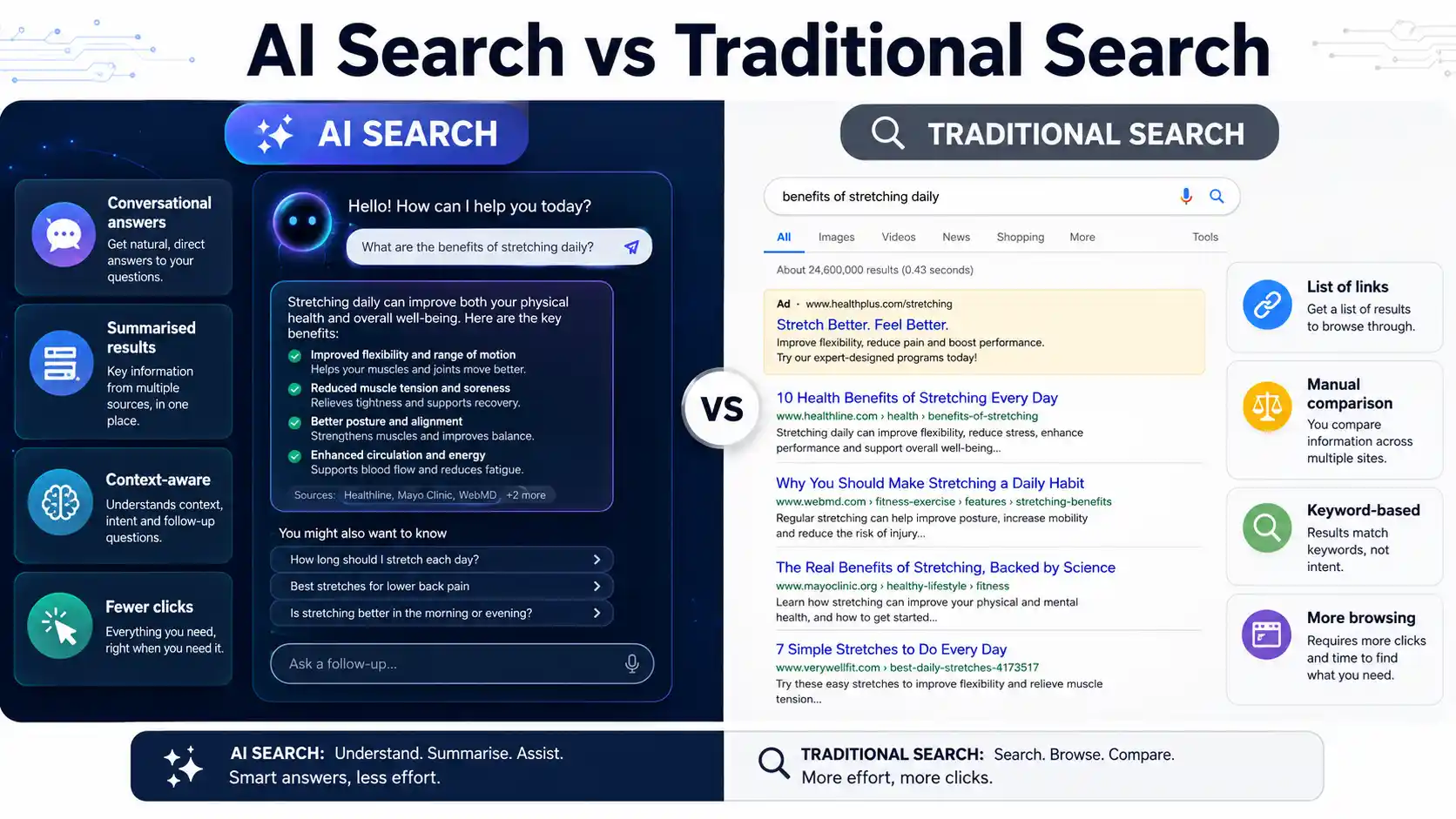
AI search gives people answers. Traditional search gives people options.
Both matter, but they support different parts of the customer journey.
| Search Factor | Traditional Search | AI Search |
|---|---|---|
| Main Result Type | Ranked links, ads, maps and snippets | AI-generated answers and summaries |
| User Behaviour | Click, compare and decide | Ask, refine and shortlist |
| Query Style | Short keywords and search queries | Longer, conversational user questions |
| Business Goal | Win rankings and clicks | Earn mentions, trust and citations |
| Best Content Type | Service pages, blogs, local pages and product pages | Clear answers, comparisons, FAQs and expert explanations |
| Measurement | Rankings, clicks, impressions and conversions | Brand mentions, referrals, branded search lift and assisted conversions |
| Trust Signals | Reviews, backlinks, website quality and local presence | Entity clarity, source consistency, expertise and structured answers |
Traditional search still drives many direct leads. AI search now influences what people believe before they become a lead.
Why Does This Matter for Australian Businesses?
Australian customers rarely follow one straight path anymore.
A person might see an AI summary, ask ChatGPT for advice, check Google reviews, visit your website, compare two providers and then call. That journey can happen across several search experiences in a few minutes.
This matters because AI tools can shape the shortlist early. Your business may never get considered if an answer engine does not understand what you do, where you operate or why customers should trust you.
For local Australian businesses, this can affect:
- Service enquiries
- Local search visibility
- Brand trust
- Google Business Profile performance
- Blog traffic
- Lead quality
- Competitor comparisons
- Reputation signals
- Brand mentions across AI and search platforms
Strong local SEO still matters for Australian businesses that rely on suburb, city and “near me” searches. A strong website still matters too. Clearer, more useful content now matters even more.
Is AI Search Replacing Traditional Search?
AI search is changing traditional search, not replacing it.
People still use Google to check brands, read reviews, compare services and take action. They still want maps, phone numbers, opening hours, images, pricing clues and proof.
AI search often supports the earlier research stage. It helps users understand a topic, narrow choices and form questions. Traditional search still supports validation and action.
A simple example makes this clear.
A business owner may ask ChatGPT, “What should I know before hiring a bookkeeper?” Then they may search Google for “bookkeeper Penrith” and check local providers. After that, they may visit two websites, read reviews and make a call.
AI helped with education. Traditional search helped with decision-making.
How AI Search Changes SEO Strategies
AI search changes SEO strategies because content now needs to work for both humans and machines.
Old SEO often focused too heavily on keywords, headings and backlinks. Those still matter, but AI search rewards content that gives direct, useful and trustworthy answers.
Google’s helpful content guidance makes this clear: content should serve people first, show real value and help users complete their task.
Your content should now help AI tools understand:
- Who does your business help
- What services do you provide
- Where you operate
- Why your advice has authority
- What makes your offer different
- What customers should do next
- Which user questions can your business answer well
AI search now connects closely with AI search optimisation, because answer engines need clear, trusted and well-structured content before they can reference a business.
This does not mean stuffing pages with AI keywords. It means creating content with better structure, stronger proof and clearer answers.
Strong AI-ready content usually includes:
- Direct answers near the top of each section
- Natural question-led headings
- Simple explanations
- Clear service descriptions
- FAQs with helpful answers
- Comparison tables
- Local examples
- Author details or business credentials
- Updated dates
- Internal links to related pages
- Consistent business information across the web
- Schema markup that supports search understanding
AI tools need confidence before they mention a business. Confusing, thin or vague content gives them very little to work with.
What Has Not Changed?
Good SEO still starts with a healthy website.
Search engines and AI systems still need to find, read and understand your pages. That means technical SEO, crawlability, page speed, internal links and clean site structure still matter.
Google Search Central still gives businesses a useful foundation for understanding how Google discovers, crawls and ranks pages.
Google still values helpful content, experience, expertise and trust. Customers still care about reviews, proof, pricing clarity and service quality.
Australian businesses should not abandon traditional SEO for AI search optimisation. That would create a new problem while trying to solve an old one.
The smarter move is to strengthen the SEO foundation and then build AI visibility on top.
What Content Works Best for AI Search?
AI search favours content that answers real questions clearly.
A general blog with broad advice may help, but specific content usually performs better. AI tools need detail. They need context. They need confidence.
Helpful blogs, FAQs and service pages all support content marketing, especially when they answer real customer questions in plain English.
Useful content formats include:
Comparison Content
Comparison pages help users understand choices. Examples include:
- AI search vs traditional search
- SEO vs Google Ads
- In-house bookkeeping vs outsourced bookkeeping
- Ducted vs split system air conditioning
These pages work well because AI tools often answer comparison-style questions.
FAQ Content
FAQs help answer engines extract short, direct answers. Each FAQ should answer one clear question in plain English.
Good FAQ topics often come from sales calls, Google Search Console, People Also Ask results, keyword research and customer emails.
Local Service Content
Australian service businesses need clear location signals. A dentist in Kings Langley, accountant in Rooty Hill or demolition contractor in Sydney should make their service areas obvious.
AI tools may use local context when they answer “near me” or city-based queries. This matters for AI search Australia because local trust signals can influence how a business appears in AI-assisted research.
How-To Guides
Step-by-step guides help users learn and help AI tools understand your expertise.
A good guide explains the process, common mistakes, costs, risks and next steps. It also gives AI models clearer context when they generate responses to practical questions.
Expert Explainers
Expert articles help answer engines connect your brand with a topic. These articles should include practical examples, not generic filler.
This type of content builds authority over time because it shows depth, experience and topical relevance.
How Can Australian Businesses Prepare?
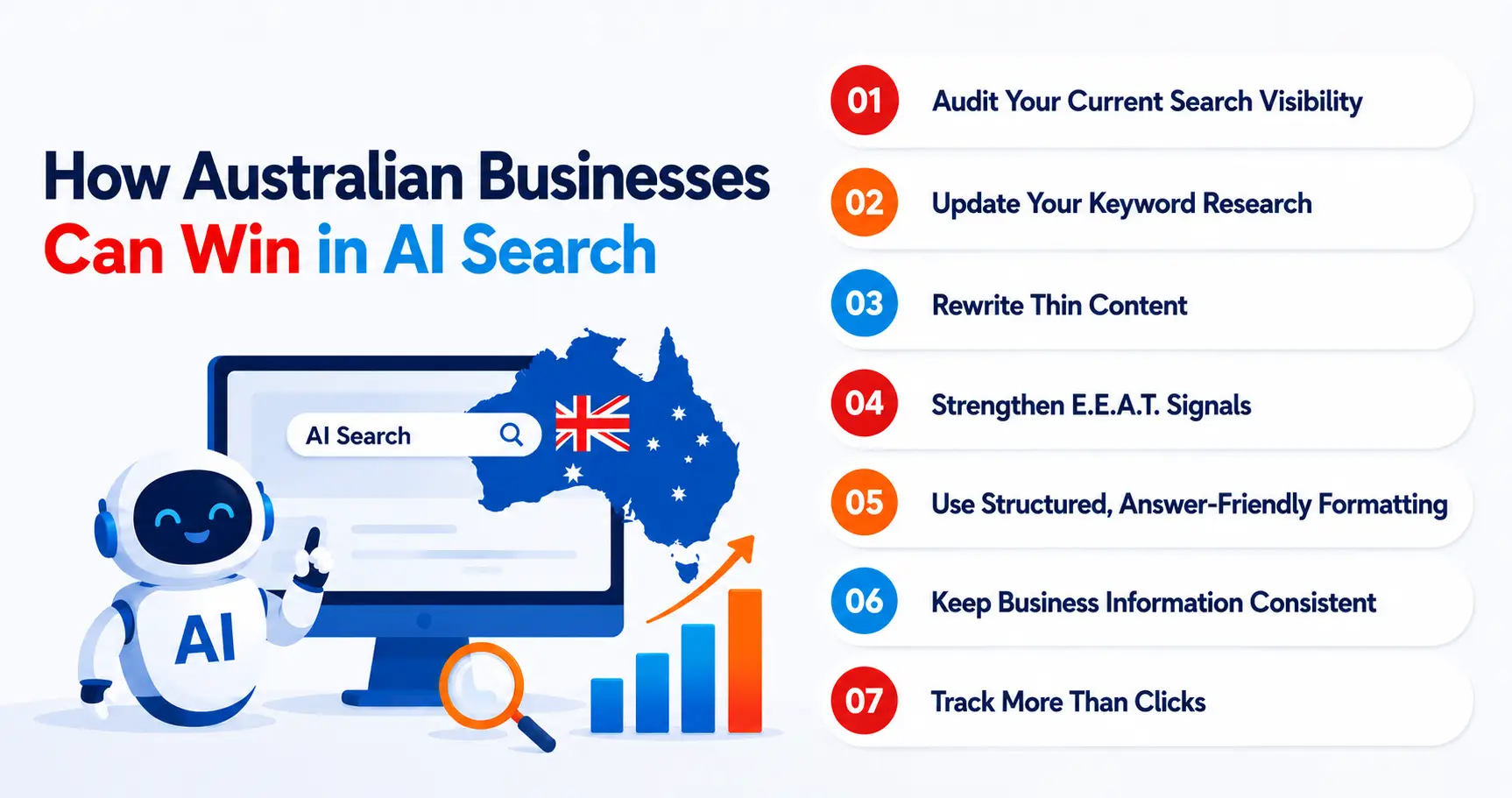
Australian businesses can prepare by improving the quality, structure and consistency of their online presence.
1. Audit Your Current Search Visibility
Start with your main services and locations. Search for them on Google. Then ask AI tools similar questions.
Look for:
- Which competitors appear often
- What answers mention your brand
- What questions trigger AI summaries
- Which pages earn visibility
- What information looks outdated or thin
- Which search queries already bring qualified traffic
This gives you a clearer view of your real search presence.
2. Update Your Keyword Research
Keyword research still matters, but it now needs a broader view.
Do not only look at short keywords. Review long-tail search queries, customer questions, comparison searches and “best option” searches. These phrases often show how people speak to AI tools and search engines.
A better keyword list should include:
- Main service keywords
- Local keywords
- Question-based keywords
- Comparison phrases
- Problem-led phrases
- Buying intent phrases
This approach helps your content support both traditional rankings and answer engine optimisation.
3. Rewrite Thin Content
Thin content gives AI tools very little to reference.
Update pages that only list services without explaining them. Add clear answers, process steps, local relevance, proof and FAQs.
A service page should help a customer understand the service before they call.
4. Strengthen E.E.A.T. Signals
E.E.A.T. stands for experience, expertise, authoritativeness and trust.
For a business website, that can include:
- Real team information
- Years of experience
- Case studies
- Service process details
- Qualifications
- Customer reviews
- Industry memberships
- Before and after examples
- Clear contact details
- Accurate business hours
Trust signals help both search engines and people. They also help AI models connect your brand with reliable, topic-specific information.
5. Use Structured, Answer-Friendly Formatting
AI tools can understand content more easily when the page structure makes sense.
Use:
- One clear H1
- Logical H2 and H3 headings
- Short paragraphs
- Tables for comparisons
- Bullets for lists
- FAQs for common questions
- Descriptive image alt text
- Internal links to related pages
- Schema markup for key page types
Google’s structured data guidance also helps businesses understand how schema can support clearer search interpretation.
Good formatting helps readers, too. That matters more than ever.
6. Keep Business Information Consistent
AI systems may compare information from several sources. Conflicting details can weaken trust.
Check your:
- Website
- Google Business Profile
- Facebook page
- LinkedIn page
- Directory listings
- Review platforms
- Local citations
Local businesses should keep their Google Business Profile optimisation up to date because AI tools and search engines can use business details, reviews and service information as trust signals.
Your name, address, phone number, opening hours and service descriptions should match wherever possible.
7. Track More Than Clicks
AI search can influence customers before they visit your website. That makes measurement harder.
Track:
- Organic traffic
- Branded searches
- Direct enquiries
- Referral traffic from AI tools
- Google Business Profile actions
- Assisted conversions
- Search Console query changes
- Lead quality
- Mentions in AI-generated answers
- Brand mentions across search and AI platforms
GA4 traffic acquisition reports can help businesses review where website visitors come from and how different channels support enquiries.
Clicks still matter, but they no longer tell the whole story.
Common Mistakes Businesses Make
Many businesses react to AI search in the wrong way.
Mistake 1: Ignoring Traditional SEO
AI visibility often depends on strong web visibility. A weak site will rarely perform well in answer engines.
Mistake 2: Publishing Generic AI Content
Generic content creates noise. It does not show expertise, local relevance or real business insight.
Mistake 3: Chasing Mentions Without Building Trust
AI tools need evidence. Customers do too. Reviews, proof, credentials and clear service information all support trust.
Mistake 4: Treating AI Search as a Separate Channel
AI search, traditional SEO, content marketing, local SEO and brand reputation now overlap. A single-channel approach can miss the bigger picture.
Mistake 5: Forgetting the Customer
Search tools may change, but customers still want simple answers. They want to know what you do, whether you can help, what happens next and why they should trust you.
What Should Australian Businesses Do Next?
Australian businesses should build a search strategy that covers both ranking and recommendations.
Traditional search helps you appear when people actively look for services. AI search helps you appear when people ask for guidance, comparisons and recommendations.
A stronger digital marketing strategy helps businesses connect AI visibility, organic rankings, local SEO, content and lead tracking in one clear plan.
The strongest approach includes:
- A technically sound website
- Clear service and location pages
- Helpful blog content
- Strong FAQs
- Fresh and accurate business details
- Reviews and trust signals
- Structured content for answer engines
- Regular content updates
- Measurement across traffic, leads and brand visibility
- Better brand mentions across relevant online sources
- Content that answers user questions clearly
A business does not need to panic. It needs to adapt.
FAQ
Is AI search replacing traditional search in Australia?
AI search is not replacing traditional search. It now works beside it. Australians still use Google, maps, reviews and websites to make decisions. AI search often helps with early research, while traditional search still supports comparison, trust checks and enquiries.
How does AI search affect SEO strategies?
AI search affects SEO strategies by placing more value on clear answers, trusted sources and structured content. Businesses still need rankings, but they also need content that AI models can understand, summarise and reference in AI-generated answers.
Do Australian businesses still need Google rankings?
Australian businesses still need Google rankings because customers use Google for local searches, service comparisons, reviews and contact details. AI search may reduce some informational clicks, but strong Google visibility still supports trust, enquiries and sales.
How can my business appear in AI-generated answers?
Your business can improve visibility in AI-generated answers by publishing clear service content, answering common questions, using schema markup, building topical authority and keeping business details consistent. Reviews, case studies, author information and strong local pages can also help.
What is answer engine optimisation?
Answer engine optimisation means improving your content so AI tools, search assistants and answer engines can understand and reference it. It focuses on clear answers, structured pages, entity signals, helpful FAQs, brand authority and trusted information.
What is the best content for AI search?
The best content for AI search gives direct answers to real customer questions. Comparison pages, FAQs, how-to guides, local service pages and expert explainers often work well. The content should sound natural, use clear structure and include proof where possible.
Should small businesses care about AI search?
Small businesses should care because AI tools can influence customer research before a website visit. A local business with clear content, strong reviews and consistent online details can earn trust across both traditional search and AI-assisted discovery.

Book a Free Strategy Session
1 business day response
100% confidential
No obligation
Client praise
Loved by clients across every industry
Your feedback is incredibly important to us. Explore testimonials from our valued clients — their words shape how we build every campaign.
See More Reviews
Trusted partners
We proudly work with different industries of all sizes
Client success is always a priority for us. We deliver high-quality solutions tailored specifically to our clients' needs — helping them achieve their goals across every industry.
NDIS & Disability
Dental
Chiropractic
Physiotherapy
Legal
Real Estate
Hospitality
Restaurants
Fitness
Trades & Building
eCommerce & Retail
Automotive
Tourism & Travel
Education
Some of our happy clients


We're ready to listen...
Leave your details below or call us on 1300 189 687 and let's chat about your business, your goals, and how we can help you grow. No obligation. No cost.