Friendly customer service and expert in their field recommend everybody who is looking best finished product and joyful experience.
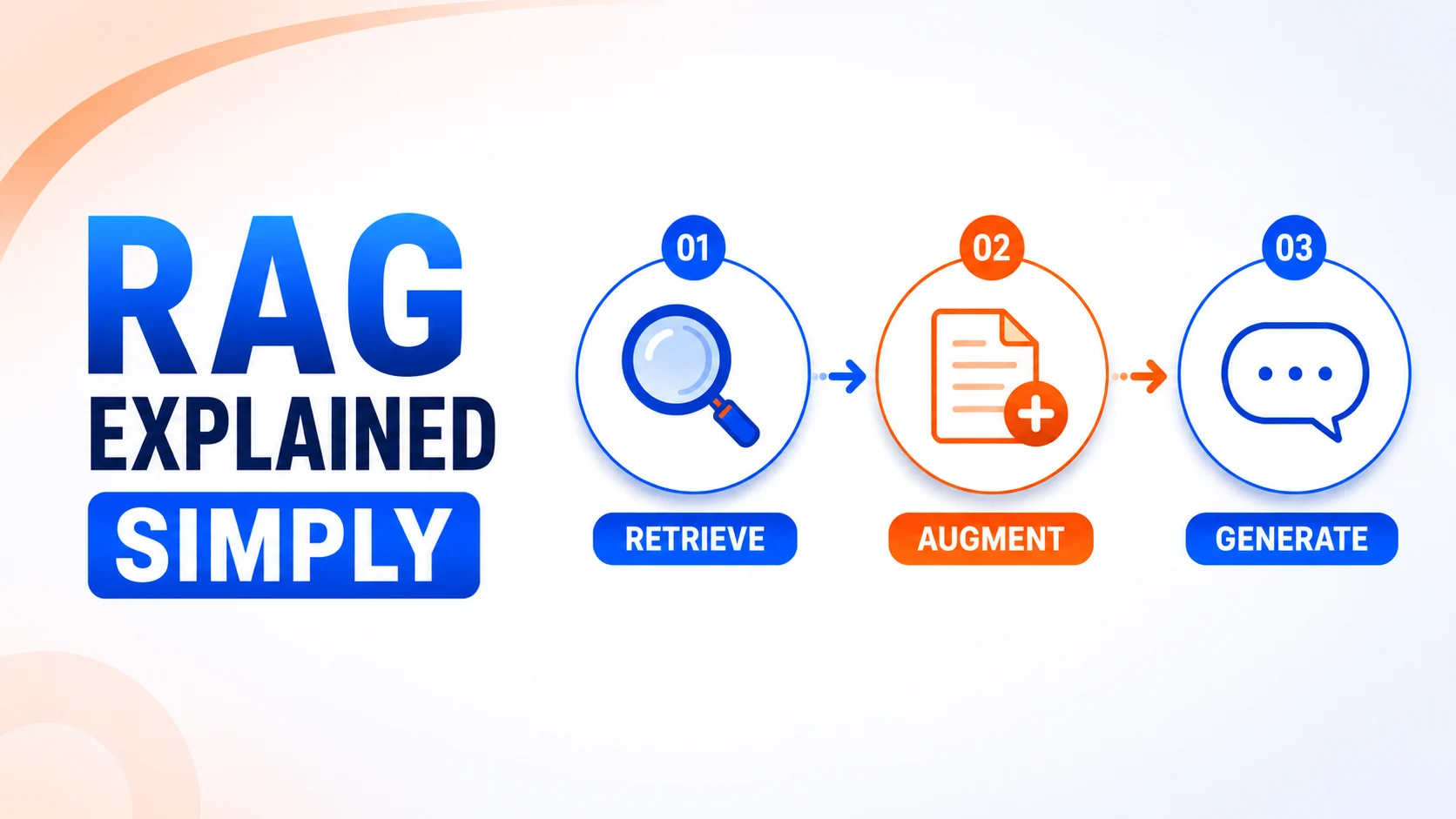
How AI Search Engines Actually Work (RAG Explained Simply)
Ask ChatGPT a question about something that happened this week, and it won’t just make something up from memory. It goes and looks something up first, then writes an answer based on what it found. That process has a name: Retrieval-Augmented Generation, or RAG. It sits behind almost every AI search experience in use right now, from Google’s AI Overviews to Perplexity to Microsoft Copilot.
This isn’t a “10 AI search tips” listicle. This is how AI search works, broken into the parts that actually matter, and what each one means if you want your own content noticed, structured properly, and showing up in the AI-generated answers people now rely on.
1. Why AI search needed a fix in the first place
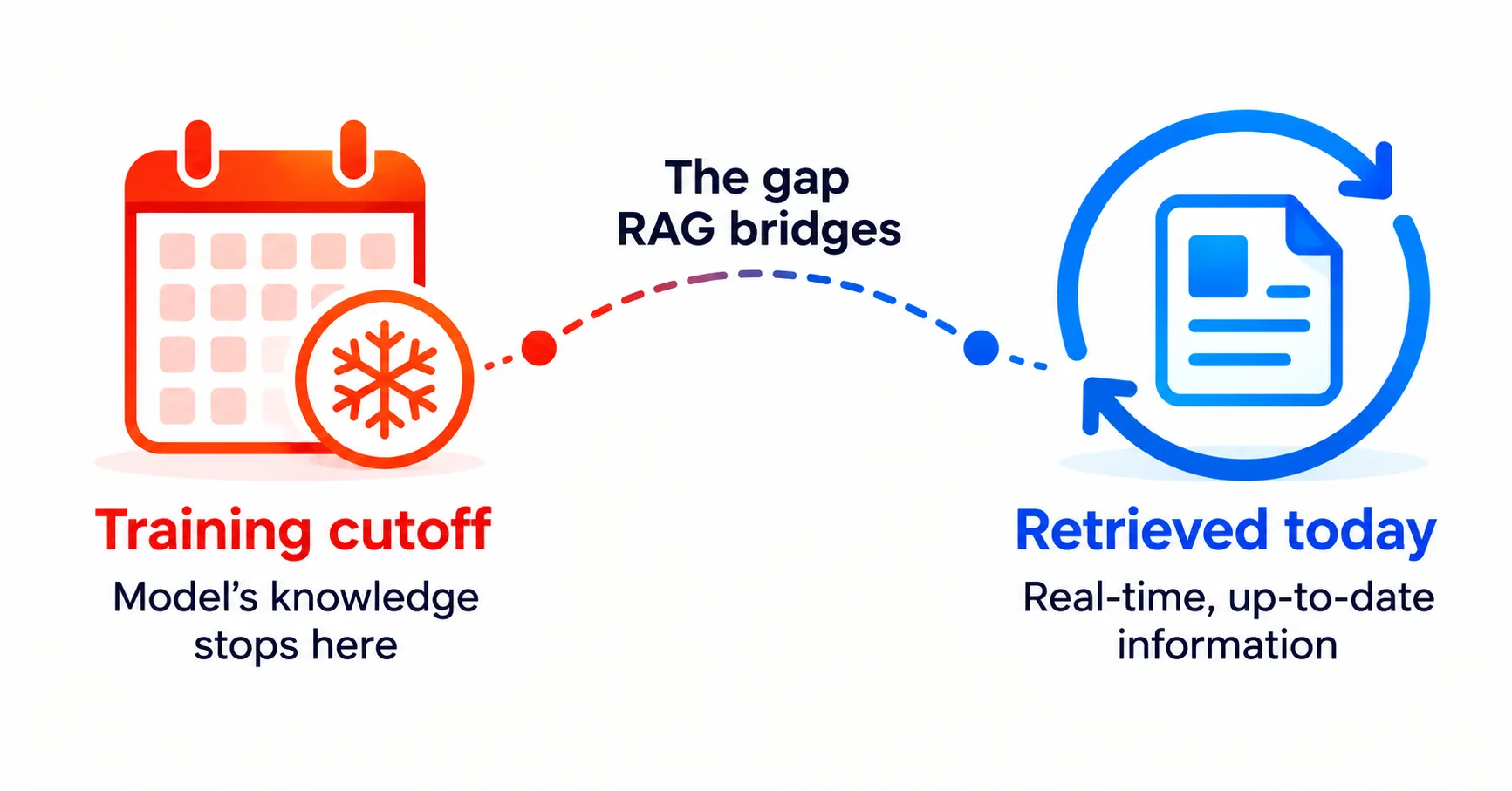
Large language models (LLMs) like GPT or Gemini are trained on huge amounts of text, then frozen. Once training ends, the AI model’s knowledge stops updating. Ask a frozen model about something that happened last week, and it has two options: admit it doesn’t know, or guess and risk being wrong. That second option is what people call AI hallucination, and it is a major trust problem for any AI model that answers without checking its facts first.
RAG exists to solve exactly this. Rather than relying only on what the model memorised during training, RAG lets the model fetch fresh, relevant information the moment you ask your question, then use that information to write its answer. It leans heavily on natural language processing (NLP) and information retrieval to work out what a search query actually means, not just which words it contains. The concept was formally introduced in a 2020 research paper by Meta AI (then Facebook AI Research), which combined pre-trained language models with external knowledge retrieval. It has become the backbone of nearly every AI search tool released since.
What to do: Evaluating an AI search tool for accuracy? The first question worth asking is whether it retrieves live sources at all, or answers purely from training memory. Models without retrieval built in are far more likely to hallucinate on anything time-sensitive.
2. Retrieval: the system looks before it writes anything
Type a search query into an AI search tool and the system doesn’t go straight to writing an answer. First it performs information retrieval across an index of content, similar in spirit to how traditional search engines like Google crawl and index the web, to find pages, passages or documents that seem relevant to your question. Rather than just matching keywords, this search usually looks for content that means the same thing as your question, even if the wording is completely different.
For AI Overviews specifically, Google has confirmed it often runs several searches behind the scenes rather than just one. In its own documentation on AI features, Google explains that both AI Overviews and AI Mode may issue multiple related searches across subtopics and data sources to build a single response, a process it calls “query fan-out”. One question you type might trigger five or six separate searches happening invisibly in the background.
What to do: This is the step where being retrievable matters more than being ranked first. A page that isn’t clearly structured, marked up with schema, and easy to crawl can miss the retrieval step entirely, no matter how strong its classic search ranking is.
3. Augmentation: fresh information gets bolted onto the model
Once the system has retrieved a handful of relevant sources, it feeds that content into the AI model alongside your original question. This is the “augmented” part of Retrieval-Augmented Generation. The model’s usual training knowledge gets topped up with fresh, specific material pulled just for this query.
This step is why AI search answers can reference things that happened after a model’s training cutoff, and why the same question asked on two different days can return a slightly different answer. The retrieved sources change; the underlying model doesn’t.
What to do: Don’t assume an AI system “knows” your business just because it was trained on a large chunk of the internet. What it retrieves today matters far more than what it may have absorbed during training. Keep your key facts, pricing and claims current on your own site, because that directly affects what gets fed into this step.
4. Generation: the model writes, and usually shows its work
Finally, the language model writes a response using both its general training and the freshly retrieved sources as grounding. A well-built RAG system leans on the retrieved content for anything specific or factual, using its own training mainly to shape the language and fill in general understanding. That is how AI-generated summaries end up sounding coherent and current at the same time, rather than reading like something frozen in time.
The output usually comes with AI citations or linked sources, which is precisely why AI Overviews, Perplexity and similar tools show a row of source links beneath their answer. Those links aren’t decorative. They are a direct trace back to the content the retrieval step pulled in.
What to do: To check whether your content is actually being used by an AI system, look at the cited sources under its answers, not just whether the answer sounds like something you’d say. Citation is the real signal. Paraphrased similarity isn’t proof of anything.
5. AI search vs traditional search: How AI Search Works
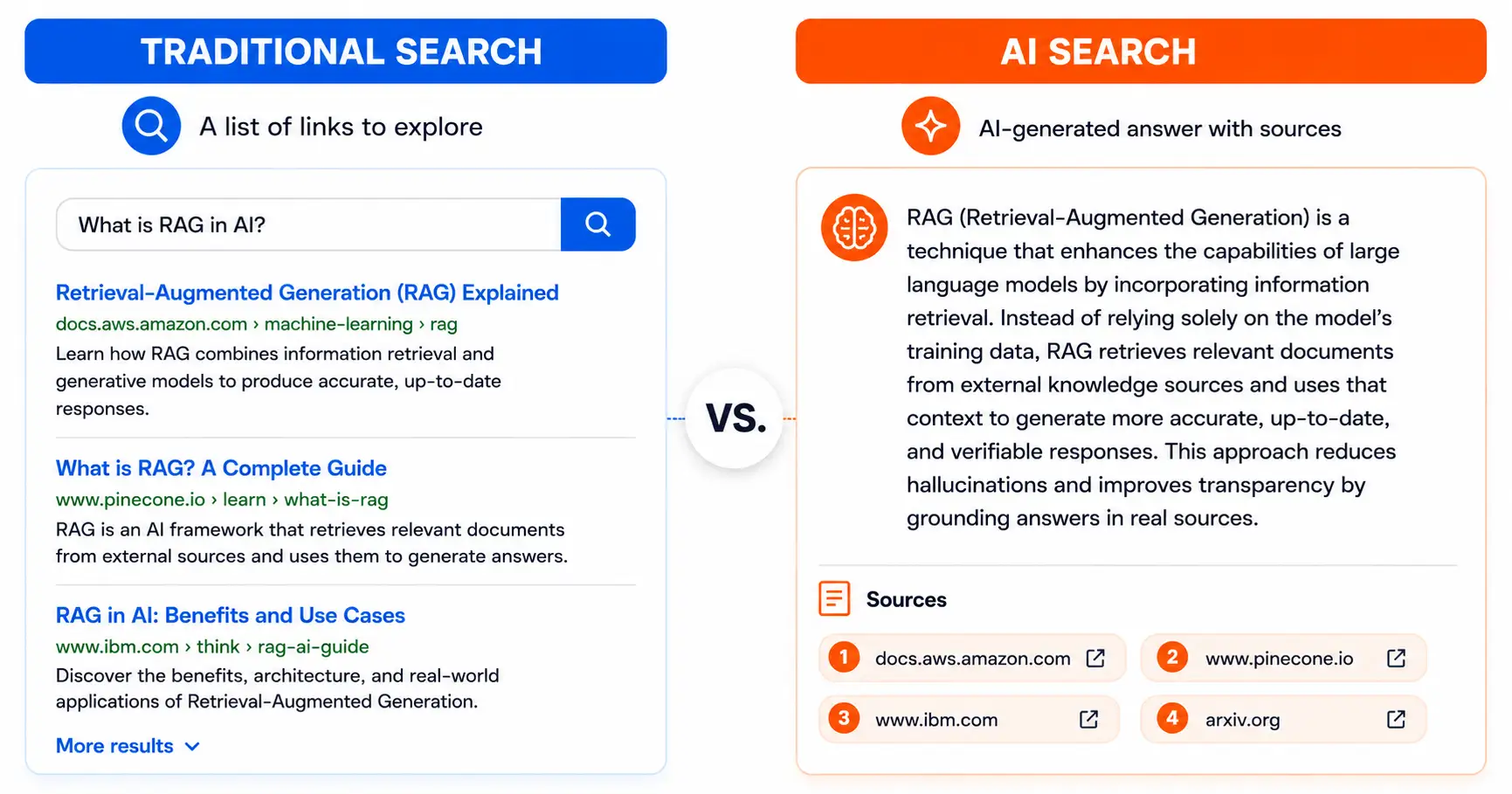
Traditional search engines return a ranked list of links and let you do the reading. AI search reads the pages for you and hands back a synthesised answer, with sources attached for anyone who wants to dig further. Both still depend on crawling, indexing and ranking content, which is why the fundamentals of SEO haven’t disappeared. They have gained a second layer on top. This shift also changes the experience in a real way: people spend less time comparing links and more time reading a single generated answer before deciding whether to click through at all. Our guide to AI search vs traditional search covers what this means in practice for Australian businesses.
What to do: Stop treating “ranking well” and “being retrieved and cited by AI” as the same goal. They overlap heavily but aren’t identical, and a strategy that chases only one leaves the other underserved.
6. Retrievability is quietly becoming its own skill
Since RAG systems retrieve real content before generating an answer, being retrievable is now as important as being rankable. A page that is clearly structured, factually specific and easy to crawl has a genuine shot at being pulled into an AI answer. A page that is vague, keyword-stuffed or buried behind heavy JavaScript rendering usually won’t survive the retrieval step at all, no matter how well it might have ranked in classic search years ago.
Google has been explicit that this isn’t a separate discipline from SEO. Its guide to optimising for generative AI features recommends developing unique, expert-led content that provides real value, rather than chasing “AEO/GEO hacks” like content chunking or unnecessary AI text files. Put simply: the retrieval step rewards useful, expert content, not tricks aimed at gaming it.
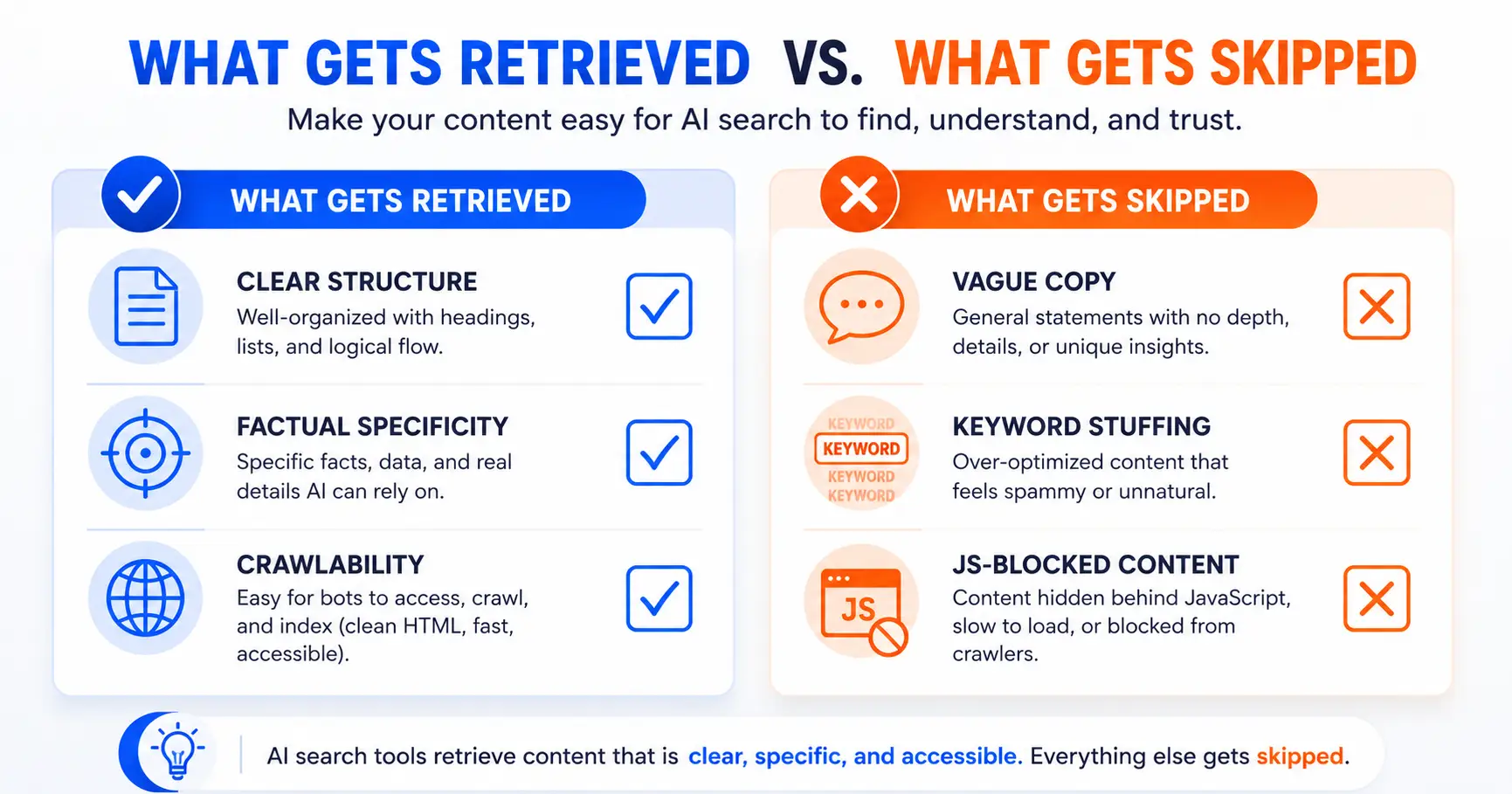
What to do: Audit your key pages for retrievability, not just rankability. Is the core answer stated plainly near the top? Does the page use schema markup so search engines and AI systems can read it precisely? Are headers phrased the way people actually ask questions? Is the page readable without JavaScript? For a deeper walkthrough, see our guide on ranking in Google AI Overviews, and for a broader content strategy shift, our explainer on Generative Engine Optimisation (GEO) covers how GEO differs from traditional SEO and where the two overlap.
7. This shift is already measurable in Australia
This isn’t hypothetical. Australians are already changing how they search, browse social media and expect answers on the spot. Our breakdown of AI search statistics in Australia shows AI tools gaining real ground on traditional search share, which means the retrieval step described above is increasingly the first thing standing between your website and a potential customer.
What to do: Treat AI visibility as a metric worth tracking now, not something to revisit “once it matters more”. Dedicated AI visibility tools can check whether ChatGPT or Google AI Overviews mention your business when someone asks a relevant question. Our comparison of AI visibility tools covers the current options if you want to measure this rather than guess.
The bottom line
RAG isn’t a buzzword. It is the mechanism deciding whether AI search tools can find your content, trust it enough to use it, and cite it back to the person who asked. Retrieve, augment, generate: three steps, and every one rewards content that’s current, clearly structured and useful over content that’s merely well-ranked. The businesses adjusting to that now, while most of the market still treats AI search as an afterthought, are the ones building a real advantage before it becomes table stakes.
The mechanics are the easy part. Turning that understanding into a content and technical strategy that actually gets retrieved is the harder one. Want help auditing where your site stands today? Our digital marketing agency team can walk you through it.
Frequently asked questions
What does RAG stand for in AI search?
RAG stands for Retrieval-Augmented Generation. It is the process of retrieving relevant information from an external source, then using that information to help an AI model generate a more accurate, up-to-date answer.
Is RAG the same as an AI Overview?
Not exactly. RAG is the underlying technique. AI Overviews, ChatGPT search, Perplexity and Copilot are all products that use some version of RAG, or a similar retrieval-based approach, to generate their answers.
Why does AI search sometimes get facts wrong?
Even with retrieval in place, the language model still has to interpret and summarise what it finds. When the retrieved sources are thin, outdated or contradictory, the generated answer can still be inaccurate.
Does AI search replace the need for SEO?
No. RAG systems still rely on crawling, indexing and content quality signals that are core to SEO. What has changed is that content also needs to be clear and well-structured enough to be retrieved and summarised accurately, not just ranked.
How do I know if my website is being cited in AI search results?
Search relevant queries in tools like ChatGPT, Perplexity or Google AI Overviews and check whether your site appears as a source. For ongoing tracking, dedicated AI visibility platforms can monitor this automatically across many queries at once.

Book a Free Strategy Session
1 business day response
100% confidential
No obligation
Client praise
Loved by clients across every industry
Your feedback is incredibly important to us. Explore testimonials from our valued clients — their words shape how we build every campaign.
See More Reviews
Trusted partners
We proudly work with different industries of all sizes
Client success is always a priority for us. We deliver high-quality solutions tailored specifically to our clients' needs — helping them achieve their goals across every industry.
NDIS & Disability
Dental
Chiropractic
Physiotherapy
Legal
Real Estate
Hospitality
Restaurants
Fitness
Trades & Building
eCommerce & Retail
Automotive
Tourism & Travel
Education
Some of our happy clients


We're ready to listen...
Leave your details below or call us on 1300 189 687 and let's chat about your business, your goals, and how we can help you grow. No obligation. No cost.