Friendly customer service and expert in their field recommend everybody who is looking best finished product and joyful experience.

How to Write Content That AI Engines Cite?
Citing your sources can more than double how much of your page ends up in an AI answer.
That’s the line you’ll see quoted everywhere, and it’s true. Sort of. The research behind it did find a 115% jump, but for the page sitting fifth in Google. The page in first place? Same change, and it lost about 30% of its visibility.
Odd result, until you think about who it helps. If you run a small business in Penrith or Geelong, you’re probably not number one for anything competitive. That’s fine. You can still be the page ChatGPT quotes, as long as you write content for AI citation on purpose. Most sites don’t. They write the way Google wanted in 2019 and hope for the best.
So here’s the plan: what the study actually tested, seven writing habits that come out of it, and how to cite sources properly on an Australian site. That last bit is weirdly hard to find anywhere.
What Is Content for AI Citation?
It’s content an AI engine can pick up, check and credit back to you. The answer comes first. The claims point to a named source. And each key point still makes sense if you rip it out of the page, which usually means keeping it to 40 to 60 words.
Why the ripping-out part? Because tools like ChatGPT and Perplexity don’t read your page start to finish the way your customers (hopefully) do. They pull out chunks, compare them with chunks from other sites, and credit a handful. A paragraph that only makes sense after the one before it doesn’t survive that. Our guide to how AI search works has the nuts and bolts.
And Australians are using these tools. A lot. YouGov surveyed 1,002 adults here this year and found 72% of online searchers use AI assistants, yet only 39% trust what comes back (full breakdown here). People use it, but they don’t quite believe it. A page that shows its sources answers that doubt before anyone raises it.
What Did the GEO Study Find About Citing Sources?
The study is called GEO: Generative Engine Optimisation. Pranjal Aggarwal and a group of researchers from Princeton and IIT Delhi published it at KDD 2024, a big data-science conference. Their method was pretty plain. Take web content. Rewrite it nine different ways. Run 10,000 search queries through an AI engine and measure how much of each version made it into the answers. (Here’s the paper on arXiv, if you like reading tables.)
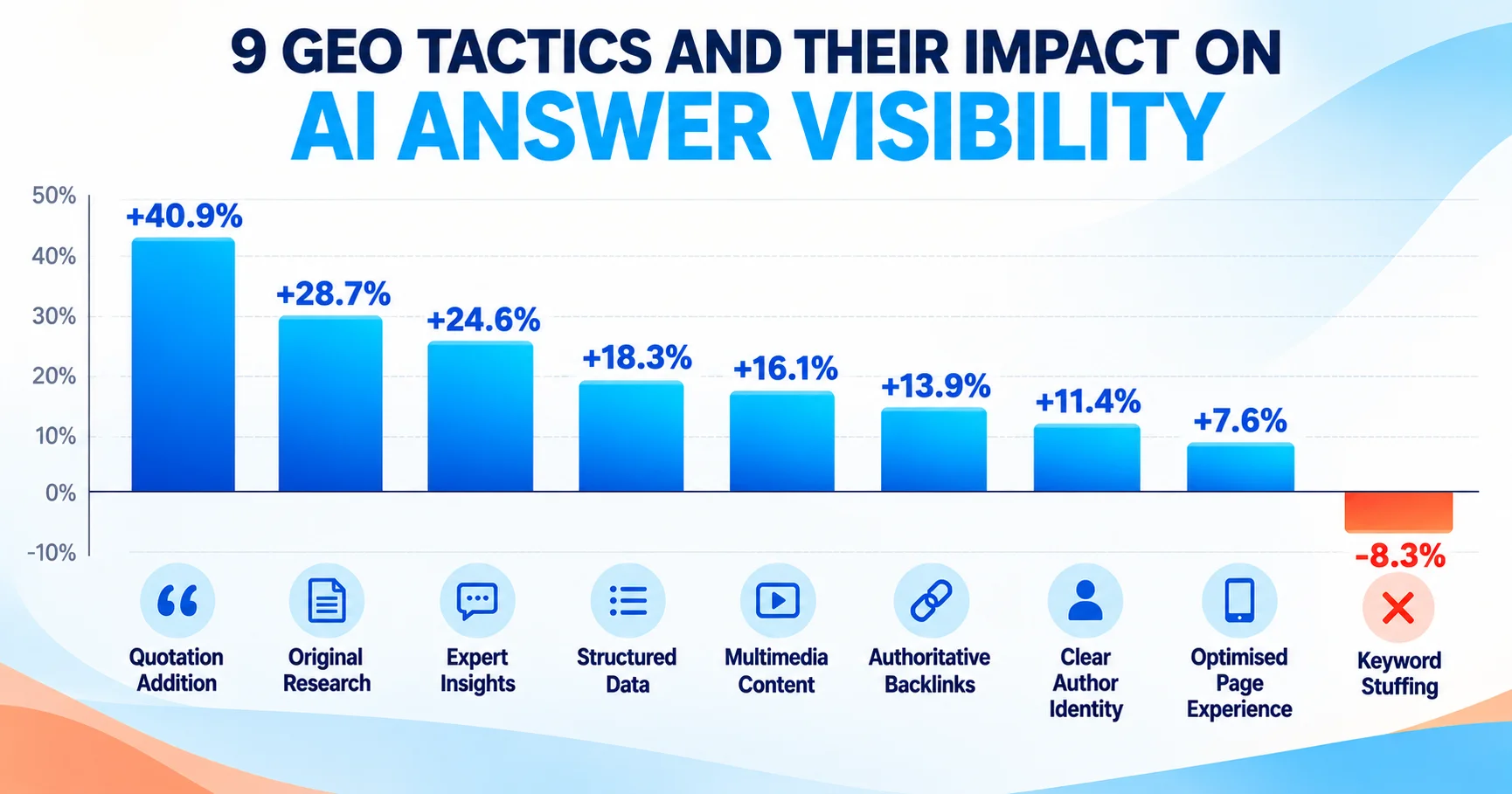
We do like reading tables. So we pulled the raw scores from the paper’s Table 1 and turned them into percentage changes you can compare at a glance.
| Tactic Tested | What It Means | Change in Word Share of the Answer | Change in Perceived Prominence |
|---|---|---|---|
| Quotation addition | Add quotes from credible people | +40.9% | +28.0% |
| Statistics addition | Swap vague claims for numbers | +30.6% | +22.8% |
| Fluency optimisation | Make the text read smoothly | +28.0% | +13.5% |
| Cite sources | Reference credible sources in the text | +27.5% | +13.5% |
| Technical terms | Use the field’s proper terminology | +17.6% | +10.9% |
| Easy to understand | Simplify the language | +14.0% | +6.2% |
| Authoritative tone | Write with more confidence | +10.4% | +18.7% |
| Unique words | Add unusual vocabulary | +6.2% | +5.7% |
| Keyword stuffing | Repeat the query’s keywords | -8.3% | +4.7% |
Source: Aggarwal et al., KDD 2024, Table 1. Percentage changes calculated by Aus Asia Online from the paper’s Position-Adjusted Word Count and Subjective Impression scores (baseline 19.3).
Notice the top four? Quotes, numbers, sources, readable writing. Evidence and clarity, basically. Then look at the very bottom. Keyword stuffing, the habit a lot of SEO was built on for years, went backwards.
Why Does Citing Sources Help Lower-Ranked Pages More?
The bit everyone skips is Table 2. There, the researchers split the results by where a page already ranked in Google. Fifth place with citations added: visibility up 115.1%. First place, same edit: down 30.3%.
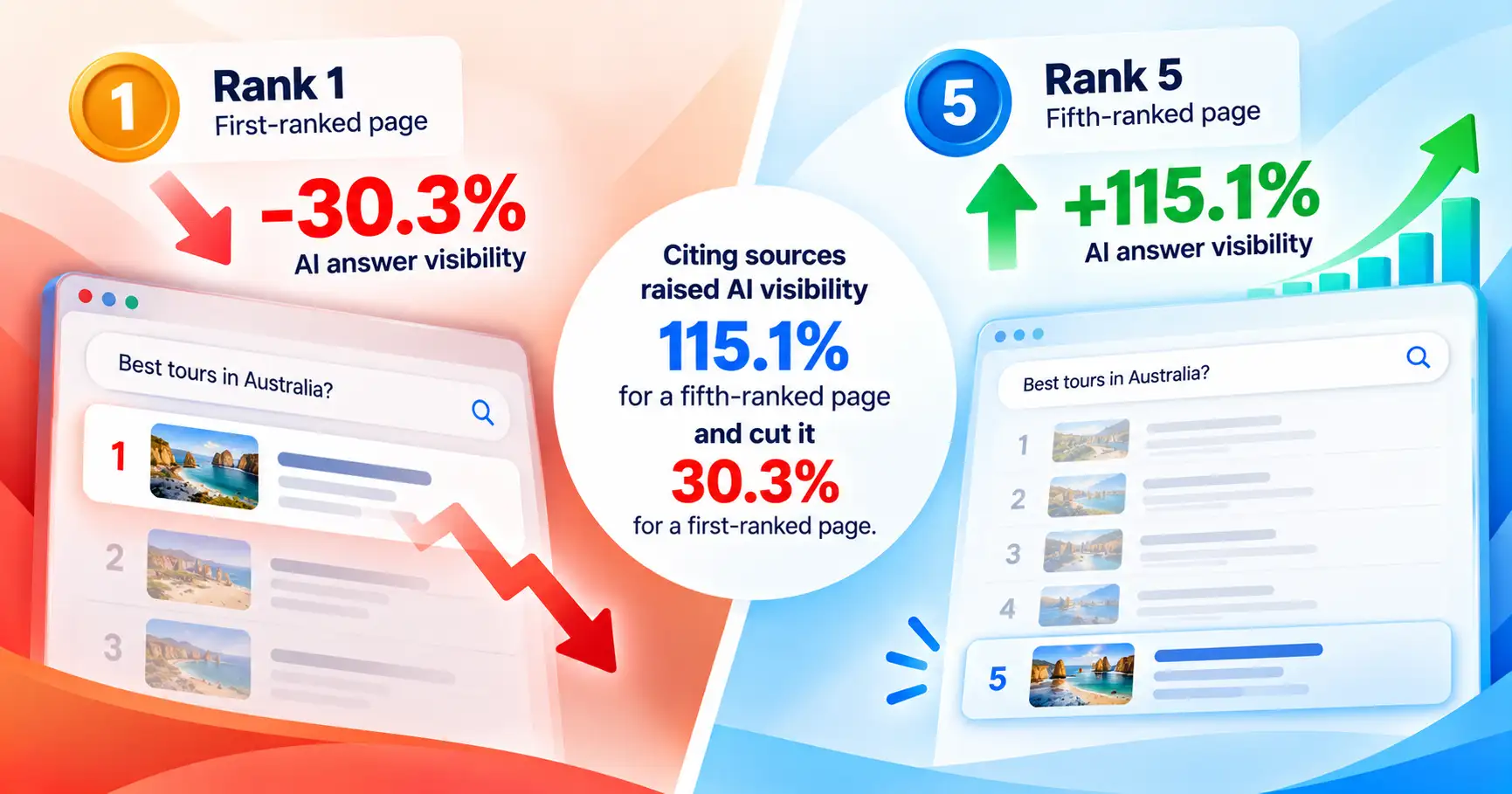
Why would the leader lose? The paper doesn’t fully pin it down, but the authors read it as GEO levelling the playing field. Our guess is that the top page already had most of the answer’s attention, so it had more to lose than gain from any edit. Either way, the upshot is clear enough: better evidence lets a smaller site punch above its ranking.
For most of the businesses we talk to, that’s the encouraging part.
How Do You Write Content That AI Engines Cite?
No secret formula here, sorry. It’s seven habits, and they work best applied to every section rather than sprinkled once at the top of the page.
1. Answer the Question in the First Sentence
Picture someone asking ChatGPT how long a strata dispute takes in NSW. Two pages could answer. One opens with the timeframe. The other spends three sentences on how stressful disputes can be. Guess which one gets quoted.
2. Cite a Primary Source for Every Claim That Matters
Name the source inside the sentence and link to the original. “The Fair Work Ombudsman says” is something a machine (or a sceptical reader) can check. “Experts say” isn’t. Skip the middleman, too. Link the government page or the actual study, not the blog post that summarised it, because the engine probably trusts the original more than it trusts either of us.
3. Use a Statistic With a Name and a Date
“Most Aussies shop online.” Okay. Probably true. Also completely unquotable, because nobody knows who measured it or when. Statistics came second in the whole study, and on live Perplexity tests they lifted perceived prominence by about 37%. If you’ve got numbers nobody else has published, even better. Our guide to using original data to earn AI citations covers how to dig them up.
4. Quote a Named Expert
This was the single best tactic in the study. It doesn’t need to be anyone famous either. Your own senior accountant counts, as long as her name and credentials sit right beside the quote.
5. Write Plain, Fluent English
Smooth, readable writing scored near the top as well. Pair it with statistics and you get the strongest combination the researchers found, at about 35.8%. Short sentences help. So does deleting the paragraph you wrote mainly to sound clever.
6. Keep Every Key Point Self-Contained
Try this on one of your own pages. Copy a key answer into a blank chat window with nothing around it. Does it still make sense? Or does it open with “This means” and leave the reader guessing what “this” is? Name the thing, and aim for 40 to 60 words.
7. Drop the Keyword Stuffing
They measured it, so you don’t have to guess. Repeating the search phrase cut visibility by 8.3% on the test engine and did worse than leaving the page alone on live Perplexity. Use your keyword where it reads naturally. Then move on.
How Do You Cite Sources So AI Engines Trust Them?
Funny thing. We went through the guides ranking for this topic and not one explains how to cite well. They just say “cite sources” and leave it there. Here’s how we do it.
- Go to the origin. Follow the number back to whoever first published it, and link there.
- Name it in the sentence. “According to the ABS” travels with the passage when an engine lifts it. A footnote gets left behind.
- Date it. “In 2026” or “as at October 2026” is enough. Perplexity in particular seems to favour recent, dated facts.
- Match the source to the claim. In the study, citing sources helped most on factual and law-and-government questions, which is exactly where an official source carries weight.
Good news if you’re in Australia: some of the best sources sit right on your doorstep.
| Your Topic | Source Worth Citing |
|---|---|
| Population, spending, business counts | Australian Bureau of Statistics (ABS) |
| Wages, awards, employment rules | Fair Work Ombudsman |
| Consumer rights, refunds, advertising claims | ACCC |
| Health practitioner rules and advertising | AHPRA |
| Your own results | Your job records, client data or surveys, with the sample size stated |
Working in health, law or finance? Then sourcing isn’t a nice-to-have. It’s part of the trust signals engines look for, and we unpack those in E-E-A-T for AI search.
What Does a Citable Paragraph Look Like?
Here’s one for a made-up physio clinic in Parramatta.
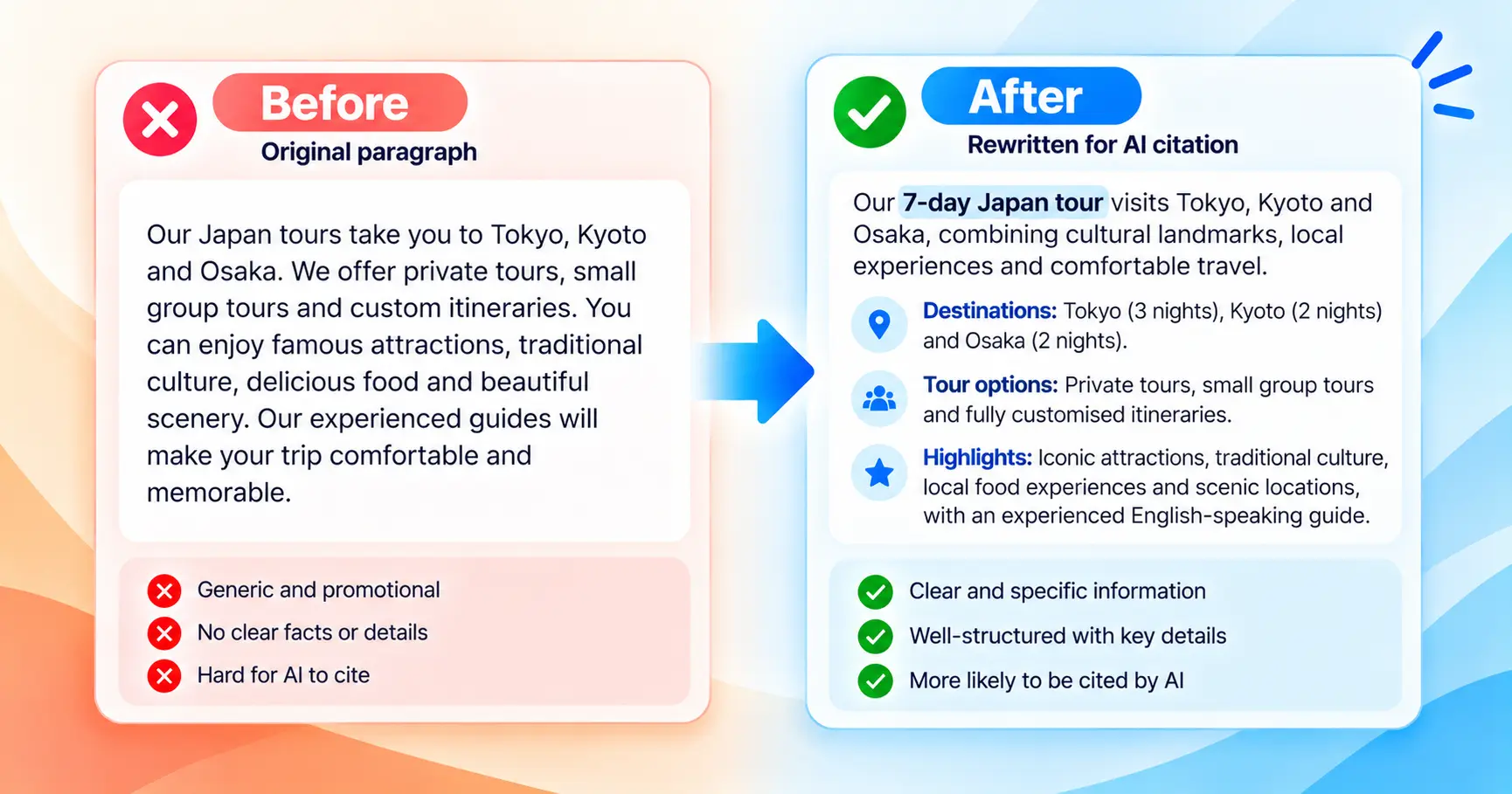
Before: “Back pain is something lots of people deal with, and it can really affect your life. Our team has years of experience helping patients feel better.”
After: “Back problems affect about one in six Australians, according to the Australian Institute of Health and Welfare. Most acute lower back pain improves within six weeks with active treatment. At our Parramatta clinic, physiotherapist Jane Lee (APA member, 12 years’ practice) starts every assessment with a movement screen.”
Same clinic. Same topic. Very different odds of being quoted. The second version leads with the answer, names a source, gives a number and puts a qualified person’s name on it, so an engine can lift any one sentence and it still stands up. (Placeholder figures and a made-up name, so check the current AIHW number and use your own clinician if you borrow this.)
Not sure how your own pages stack up? Book a free strategy session and we’ll go through your top five, passage by passage, and point out the ones an engine can’t use yet.
Does Writing for AI Search Replace Normal SEO?
Nope. Google is pretty blunt about it: there are no extra requirements to appear in AI Overviews or AI Mode, and normal SEO best practice still applies (Google Search Central). Its AI answers come from pages that already rank.
So think of this as a layer on top. A few housekeeping jobs while you’re there: make sure robots.txt lets GPTBot, PerplexityBot and Bingbot in, set up Bing Webmaster Tools (ChatGPT and Copilot both lean on Bing’s index), and put a visible “updated” date on the page. For the wider strategy, our complete guide to generative engine optimisation and the seven strategies to rank in AI-powered search are good next reads.
If you remember one thing, make it this. Evidence wins. Pages that answer plainly and show where their facts came from get quoted, and on a crowded results page, that’s how the site in fifth place ends up being the one the engine names.
Frequently Asked Questions
How do I get my content cited by AI?
Start each section with the answer, not the build-up. Back your claims with named, linked sources, and add a dated stat or a quote from someone qualified. Then sort out the basics: let AI crawlers in through robots.txt and work on ranking in Google and Bing, since that’s where most engines go looking first.
What is GEO content?
Content written so it shows up inside AI answers from ChatGPT, Perplexity or Google’s AI Overviews. That’s what GEO, generative engine optimisation, is about. In practice it means direct answers, real evidence and a clear structure. Stuffing in keywords doesn’t help. In the original GEO study, it actually hurt.
Does citing sources really increase AI visibility by 115%?
Only for some pages, and that’s the catch. The 115% figure is for a page ranked fifth in Google. For the page in first place, citing sources cut visibility by 30.3%. Across all queries the average lift was nearer 27.5%. Still worth doing. Just don’t bank on the headline number.
Do I need special schema or an llms.txt file to be cited?
Not for Google. It says plainly that AI Overviews and AI Mode don’t need special markup or AI text files. Schema still helps engines read a page, and an llms.txt file is quick to add. Neither gets you cited by itself, though. The writing and the sources do the heavy lifting.
How long does it take for AI engines to start citing new content?
It depends on the engine. Perplexity searches the live web, so a new page can start appearing within days of being indexed. Google’s AI Overviews tend to follow your organic rankings, and those take weeks or months. Easiest way to track it: ask each engine your target questions once a month and jot down which URLs it cites.

1 business day response
100% confidential
No obligation
Book a Free Strategy Session
Client praise
Loved by clients across every industry
Your feedback is incredibly important to us. Explore testimonials from our valued clients — their words shape how we build every campaign.
01 / --
Trusted partners
We proudly work with different industries of all sizes
Client success is always a priority for us. We deliver high-quality solutions tailored specifically to our clients' needs — helping them achieve their goals across every industry.
NDIS & Disability
Dental
Chiropractic
Physiotherapy
Legal
Real Estate
Hospitality
Restaurants
Fitness
Trades & Building
eCommerce & Retail
Automotive
Tourism & Travel
Education
Some of our happy clients


We're ready to listen...
Leave your details below or call us on 1300 189 687 and let's chat about your business, your goals, and how we can help you grow. No obligation. No cost.