Preparing Your Website for Google’s AI Mode – A Practical Checklist
The way we search online is changing like never before. Google has introduced AI Mode, and it’s shaking up the rules of search that we’ve known for years. Instead of just showing a list of blue links, Google’s AI-powered predictions now provide answers in a more natural, conversational way. This is not just a small update, it’s a new era, the AI Mode era, and it’s transforming how people find information online.
For businesses, marketers, and website owners, understanding Google AI Mode is more important than ever. Your website needs to be ready for AI search, so it can show up in AI Overviews, be recognised by AI algorithms, and reach users who rely on smart AI assistants.
In this guide, we’ll explain what AI Mode is, why it’s a big change, and how you can optimise your website using an AI SEO checklist. By following simple strategies, you can make sure your content stands out in this new AI Mode era and continues to attract visitors even as search becomes smarter.
So, What Is Google’s AI Mode?
Google’s AI Mode is part of the new Google AI era, powered by advanced Gemini AI technology. It’s more than a search engine; it acts like a smart assistant that understands questions, learns from them, and even helps you take action.

Imagine planning a family trip. Instead of searching separately for “fun family hotels,” “kid-friendly restaurants,” and “things to do when it rains,” you just ask Google one question:
“What are the best vacation ideas for a family of four with two kids under 10 who love nature but need indoor activities, all within 4 hours of Sydney?”
Instead of a long list of links, Google now gives you one clear, helpful answer with suggestions, details, and even next steps.
This AI-powered search can handle tricky questions, understand context, and combine information from hundreds of trusted sources. It even remembers what you asked before, making follow-up questions easy and natural.
With Google’s AI-powered predictions, search is no longer just about finding information, it’s about getting answers and taking action. That’s the power of Google’s AI Mode.
The Current AI Landscape: Where We Are Now
While Google’s AI Mode marks a major leap in the Google AI era, its rollout is careful and strategic. It doesn’t appear in every search, and understanding how it surfaces offers key insights for your AI SEO checklist. In Australia, AI-generated summaries (also known as Google’s AI Overviews) are becoming increasingly common, reflecting the country’s growing investment in artificial intelligence. The AI market in Australia is projected to grow at an impressive 28.55% annually from 2025 to 2030, reaching a total market volume of AUD 20.34 billion by 2030. This rapid growth highlights how Google’s AI-powered predictions and AI-driven tools are transforming how Australians search and interact online.
For sensitive or Your Money or Your Life (YMYL) topics such as health, finance, and legal advice, Google’s AI applies extra caution. It gathers information from multiple trusted sources and gives preference to authoritative sites like government or educational institutions. This makes E-E-A-T (Experience, Expertise, Authoritativeness, and Trustworthiness) an essential part of your Google AI mode checklist and overall strategy for success in this evolving AI-powered search landscape.
How Google’s AI Mode Is Impacting Australian Businesses?
Since Google launched AI Mode in Australia, many local businesses have noticed big changes in their online traffic. Just a few days after the update, some business owners saw fewer people visiting their websites from Google. That’s because users can now get answers directly from Google AI Overviews, so they don’t always click through to the original websites.
The effect is serious. Some Australian websites and businesses have seen traffic drop by 70–80%, especially blogs, guides, and resource pages. Fewer visits also mean fewer customers and leads coming from search.
This is the start of the AI-first search era. Simply ranking high in Google is not enough anymore. To stay visible, Australian businesses need to optimise their content for Google AI Mode. That means:
- Show authority proves you know your topic.
- Be clear and give information in a simple, easy-to-read way.
- Use structured data to organise content so AI can understand and summarise it.
Businesses that adapt early to AI-powered search will have the best chance to stay visible and grow online.

Google’s AI Mode SEO Checklist– Step-by-Step Guide
Getting your website ready for Google’s AI Mode doesn’t have to be overwhelming. By following a clear, step-by-step SEO checklist, you can ensure your content is AI-friendly, authoritative, and visible in the new AI-powered search landscape. Here’s how to start:
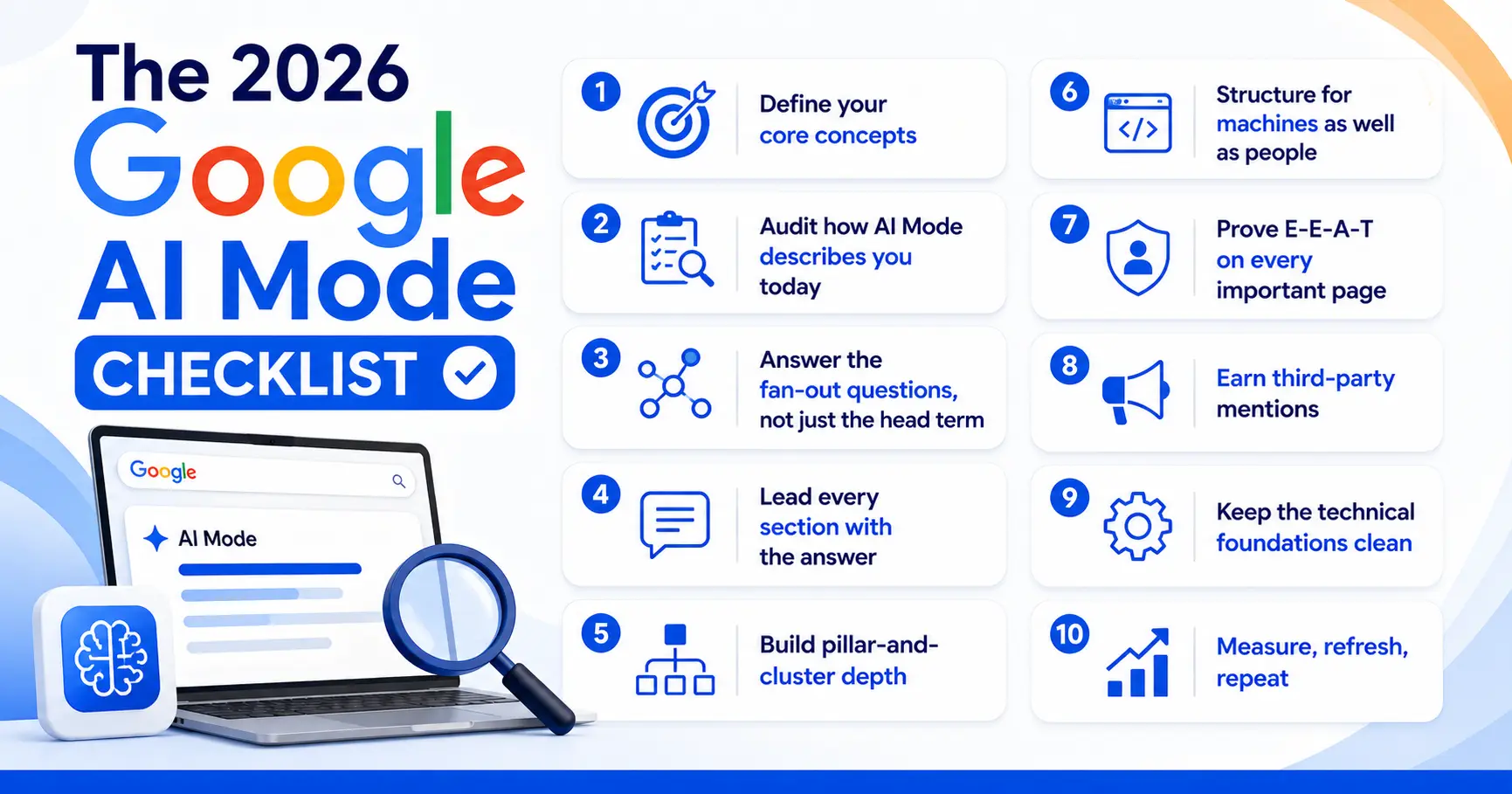
1. Identify Your Main Topics
To show up in Google’s AI Mode, the AI first needs to understand your brand. Start by picking a few core concepts and short phrases that describe what your business does, who it helps, or what makes it special.
Examples: “affordable skincare” or “no-code website builder.” These phrases act like a quick introduction to your brand and help AI know when to suggest you.
Why it matters: Google AI Mode uses Gemini 2.5, a smart AI that links ideas from the web. The more your brand is connected to certain ideas, the more likely AI will recommend it. For example, The Ordinary is always linked to “affordable skincare,” so it often comes up when people search for that.
How to define your core concepts:
- Know your audience: Think about who your brand is for, like a skincare brand for teenagers or an insurance company for parents.
- Highlight your unique value: Focus on what makes you different, like “fastest no-code website builder,” and mention it consistently online.
By clearly defining and repeating your core concepts, Google’s AI will remember your brand and suggest it in AI-powered searches.
2. Be the Go-To Expert in Your Field
In the AI-powered search world, surface-level content won’t cut it. To rank in Google AI Mode, your website must show it’s the most thorough and reliable source on your topic. AI rewards sites that offer a complete “library” of information, not just isolated articles.
Use the Pillar and Cluster model:
Build your Pillar
Create one comprehensive guide on your main topic. Example: “The Ultimate Guide to Home Gardening: From Seeds to Harvest.” Make it detailed, well-researched, and visually appealing a top resource online.
Create your Clusters
Write smaller, expert-level articles on subtopics from your pillar. Example: “Best Soil Types for Vegetables,” “Organic Pest Control Methods,” or “Indoor Gardening Tips.” Each cluster should stand alone as a detailed guide.
Link them together
Connect all clusters to the pillar page and back again. This creates a strong content hub that signals expertise and helps Google’s AI-powered predictions recognise your authority.
A structured content library like this shows AI Mode that your website is the go-to source, increasing visibility in AI-powered search and supporting your AI SEO checklist.
3. Review How You Show Up in AI Mode
To improve your visibility in Google AI Mode, you first need to see how your brand currently appears. Search for your brand name, core services, and main areas of expertise. Are you mentioned? Is the description accurate and positive?
For example, when we searched “What is Aus Asia Online”, we saw an accurate description highlighting our digital marketing services exactly as the associations we wanted.

However, when we searched “award-winning SEO agencies in Australia”, we didn’t appear, even though we’ve earned multiple awards over the years. This shows that Google AI Mode hasn’t yet linked our brand with that phrase, highlighting an area for improvement.

Auditing your AI presence also helps you validate your core concepts. It reveals what AI currently associates with your brand versus what you want it to know. Check competitors too, which terms do they own in AI Mode, and where are the content gaps?
Since Google AI Mode is still evolving, your visibility can change over time. Make this audit a monthly habit to stay ahead and ensure your brand is showing up where it matters most in AI-powered search.
4. Keep Consistent Messaging Across All Platforms
Google AI Mode doesn’t just look at your website; it scans your entire digital footprint, including LinkedIn, Facebook, directories, podcasts, and soon, Instagram. Everything you publish shapes how AI understands your brand.
Semantic consistency is key. Using the same core concepts across all platforms trains AI to recognise your expertise. This doesn’t mean copying word-for-word; it’s about reinforcing consistent themes and messaging in ways that suit each channel.
Example: A Sydney café, Harbour Brews:
- Website: “Sydney’s cosiest waterfront café.”
- Instagram: “Your waterfront coffee escape in Sydney.”
- Facebook: “Relax and enjoy coffee by Sydney Harbour.”
Result: When people search “best waterfront cafés in Sydney”, Harbour Brews ranks well in AI-powered search.
How to Maintain Consistency:
- Pick 2–3 core concepts and use them across all platforms.
- Audit messaging for inconsistencies and unify language.
- Create a messaging guide for tone, terms, and phrasing.
- Repeat key ideas in ways suited to each platform.
This approach boosts visibility in Google AI Mode and strengthens your overall AI SEO strategy.
5. Cover Related Topics and User Questions
Query fan-out is when Google AI Mode takes one question and splits it into several related searches to create a fuller answer. Instead of showing just one result, it explores the topic from multiple angles.
For instance, if someone asks, “What’s the best café in Sydney for remote work?” AI Mode might also check:
- “Cafés in Sydney with fast Wi-Fi”
- “Quiet cafés for studying or meetings”
- “Cafés with power outlets near the harbour”
This means a single page or keyword isn’t enough. To appear in Google AI-powered predictions, your website should cover all related questions so your brand becomes a go-to source.
Ways to find these related queries:
- Use Gemini 2.5 to discover likely follow-up questions.
- Check Google’s “People also ask” or tools like AlsoAsked.
- Look at competitors in Google AI Mode to see what subtopics they cover.
By mastering query fan-out, your brand doesn’t just answer a question it becomes an authority in the Google AI overview, improving your presence in AI-powered search results.
6. Improve Content Layout for AI Readability
Google’s AI Mode doesn’t just read your website like a normal search engine. It analyses every part of your content to understand what your page is about. To get noticed by Google’s AI-powered predictions or appear in Google’s AI overview, your website needs a clear structure and proper signals.
Use Schema Markup
Structured data tells Google AI Mode exactly what type of content you have. This helps it show your page correctly in AI-generated summaries. Examples include:
FAQPage for FAQs
- Article or BlogPosting for guides and blog posts
- Product or Review for eCommerce pages
Adding structured data makes your website easier to read for AI and improves your AI SEO checklist.
Organise Your Page Well
Google AI Mode also looks at how your page is structured. Follow these tips:
- Headings (H1, H2, H3): Use one H1 for the main topic and H2 or H3 for subtopics.
- Lists and Tables: Bullet points, numbered lists, and tables help AI quickly understand your content.
- Bold Important Words: Highlight key phrases so AI can find them easily.
A well-organised page increases your chances of being featured in Google AI mode results and improves your overall AI SEO performance.
7. Share Real Experiences and Insights
Google AI Mode prefers first-hand experience over generic advice. Just repeating what others say won’t help your content appear in AI-powered predictions or overviews.
This ties into Google’s E-E-A-T framework: Experience, Expertise, Authoritativeness, and Trustworthiness. AI Mode now emphasises Experience proof that you’ve actually used a product, tried a strategy, or tested advice.
Ways to show real expertise:
- Include author credentials highlighting hands-on experience.
- Share quotes from internal specialists.
- Add case studies with clear actions and outcomes.
- Use screenshots, visuals, or process videos.
- Keep content updated for fast-changing topics.
Example: A blog on “Best Productivity Tools for Small Sydney Businesses” became visible in AI Mode because it included:
- Step-by-step trials by the team
- Screenshots showing tool usage
- Real success metrics from local businesses
Bottom line: Creating detailed, useful content based on real-world experience helps your brand stand out in Google AI Mode and boosts your position in AI-powered search results.
8. Focus on User Intent, Not Just Search Volume
For a long time, SEO meant finding popular keywords and making content around them. In the age of Google AI, this is not enough. Google’s AI-powered predictions can understand what users really mean, even if they don’t type the exact words.
- Focus on Topics, Not Keywords:
Create complete guides that cover a topic fully. This shows Google AI Mode thinks you are an expert. - Answer Hidden Questions:
Find common questions from customers or the “People Also Ask” section and answer them clearly. - Write Naturally:
Use full sentences and question-style headings. This makes it easier for AI to read and understand your content.
Get Ready for AI Agents
AI agents will act like personal helpers, completing tasks for users. They care about facts, not fancy design.
Prepare Your Site:
- Clear Structure: Use headings and Schema so AI knows what your content is.
- Accurate Info: Include exact details, prices, and availability.
- Fast & API-ready: Agents may access your site directly, so speed and structured data are key.
Following this Google AI mode checklist helps your site perform well in the AI SEO era and across AI features and your website.
9. Start Planning for “AI Agent Optimisation”
The way Aussies use the internet is changing fast. In the new Google AI mode era, many people will rely on AI helpers to get things done.
Instead of you searching for a “hotel in Sydney,” your AI might handle it:
“Find me a hotel near Bondi Beach next weekend for under $250 a night with good reviews.”
These AI tools don’t look for fancy designs, they want clear info, prices, and facts they can trust.
How to Prepare Your Website?
- Structure Content for Machines
Use simple headings and add Schema markup so Google’s AI overview can read your pages easily like your service details, pricing, or reviews. - Share Clear, Real Info
Give exact prices, availability, and contact details. Keep text short and useful perfect for Google’s AI-powered predictions. - Be Fast and Connected
Make sure your website loads quickly and consider adding an API so AI agents can access your data directly.
10. Boost Your Brand Mentions with Digital PR
The most powerful step in your AI SEO checklist is growing your brand’s visibility beyond your website through Digital PR.
AI tools like Google’s AI Mode, ChatGPT, and Gemini don’t just look at your website, they check what others say about your brand on sites like Reddit, Quora, YouTube, and local news.
If people (and AI) keep seeing your brand mentioned positively online, your chances of being featured in Google’s AI Overviews go way up. Businesses with more third-party mentions are more likely to appear in AI-generated answers.
For example, Australian brands that consistently show up in local news articles, product reviews, and online discussions are already seeing stronger visibility in Google AI Mode results.
Ways to Strengthen Your Digital PR for AI Visibility
- Create PR stories around your core topics that you want to be known for.
- Share expert insights through media platforms like Qwoted or SourceBottle.
- Join discussions in trusted online communities (Reddit, Quora, LinkedIn).
- Publish wins & research share results, client stories, or useful stats.
- Track your mentions to see how your brand is being represented online.
11. Work on CRO and UX for Better Results
As AI search reduces direct website visits, each visitor is more valuable than ever. Focus on CRO and UX to turn every click into real results.
- Easy Actions: Simple paths for users to buy, book, or enquire.
- Fast & Mobile-Ready: Quick loading and seamless on all devices.
- Clear Design: Clean layouts with strong calls to action.
- Trust Signals: Reviews, security badges, and real client stories build confidence.
12. Prepare for Visual and Voice Search (Multimodal Search)
As Google’s AI evolves, search now goes beyond text; it understands images, videos, and audio. To stay visible, your content must work across all media types.
- Plan Your Content Holistically: Make sure your strategy covers text, images, video, and audio together for maximum impact.
- Use Structured Data Everywhere: Label content with Schema markup so AI can quickly identify products, services, and key information.
- Optimise Rich Media: Use clear filenames, alt text, captions, and transcripts so Google’s AI Mode can understand your visuals and audio.
- Keep Content Connected: Make sure your videos and images add real context to your written content.
- Be Ready for Visual Search: Use high-quality, well-labelled images with Schema markup to help AI recognise your products or services.
- Enhance Audio Content: Add transcripts and summaries for podcasts or voiceovers so AI SEO tools can easily read and rank them.
13. Listen to Feedback and Keep Improving
AI and search are constantly evolving, so your website strategy must be flexible and data-driven.
- Track Engagement Metrics: Monitor time on page, bounce rate, scroll depth, and clicks. High engagement shows AI your content satisfies users.
- Review AI Overview Performance: Check if your content appears in Google’s AI Overviews and how users interact with it. Adjust content based on what works.
- Collect User Feedback: Use surveys, comments, or testing to learn how real users experience your content.
- Test and Experiment: Try different headlines, content formats, and structured data. Use A/B testing to see what resonates best.
- Stay Updated on AI: Follow Google updates, research, and industry news to keep your SEO practices aligned with AI developments.
Technical Tips to Get Your Website AI-Ready
In the Google AI Mode era, your website needs more than good content; it needs a solid technical setup so AI can understand it.
- Organise Your Content Clearly:
Use H1, H2, and H3 headings, answer questions right away, and break information into lists or tables for easy reading. - Boost Technical SEO:
Add Schema Markup to label your content, make your site fast, and ensure AI crawlers can read it using a proper robots.txt file and an XML sitemap. - Prepare for AI Interaction:
If you use JavaScript, make content visible to crawlers with Server-Side Rendering (SSR). Keep sentences simple and clear so Google AI-powered predictions can process your pages easily.
Following this AI SEO checklist helps your site perform better in Google AI Mode and across AI features and your website.
Adapting Your Content Plan for the AI Era
The old content rules don’t work in the Google AI Mode era. You need a strategy that matches how AI finds and uses information.
- Focus on Unique, Hard-to-Replicate Content:
Create expert guides, detailed comparisons, real-world case studies, and original research. This is content AI can’t generate on its own. - Target Long, Specific Questions:
Instead of generic terms like “sourdough bread,” use queries such as “How do I make a sourdough starter in a cold apartment?” These attract high-intent users and face less competition. - Write for Conversations:
Use a natural, conversational tone. Anticipate follow-up questions and structure your content to answer related queries, not just one.
Following this approach strengthens your AI SEO checklist and boosts visibility in Google AI Mode and other AI-powered predictions.
Build Trust and Authority with E-E-A-T
In the Google AI Mode era, trust is everything. AI looks for content that shows Experience, Expertise, Authoritativeness, and Trustworthiness (E-E-A-T).

Grow Your Authority Online:
- Use digital PR and brand mentions. Work with influencers, share newsworthy updates, get high-quality backlinks, and publish thought leadership content. This shows AI that your brand is credible.
Optimise for Google’s Knowledge Graph:
- Make your brand a clear “entity” using the Organisation schema.
- Keep your business info updated on Google Business Profile, Wikipedia, and other authoritative sources.
- Claim your Knowledge Panel if available to strengthen your visibility in Google AI-powered predictions.
Monitor Results and Adjust Regularly
Tracking your performance and being ready to adapt is crucial.
Monitor Your AI Performance:
- Use AI Overview Tracker tools to see when your site appears in Google AI-powered predictions.
- Check website traffic for changes in clicks and engagement.
- Track conversions and how users interact with your content.
- Monitor your brand’s authority across the web to see how AI features in your website are working.
Adapt Quickly to Google Updates:
- Follow official Google news and AI SEO updates.
- Test your content and see what performs best in Google AI Mode.
- Be ready to adjust your strategy quickly when updates happen.
- Always focus on giving users the best experience AI rewards useful, clear, and trustworthy content.
Top Mistakes to Avoid in AI Optimisation
When optimising for Google AI Mode, avoid these pitfalls:
- Focusing only on old SEO metrics like rankings or traffic. AI values relevance and usefulness.
- Creating generic content that adds no unique value. Stand out with expert insights and real examples.
- Ignoring your brand reputation across the web. AI checks credibility everywhere.
- Neglecting user experience. Every visitor counts make your website fast, clear, and easy to use.
- Working in silos. Collaboration between content, SEO, and technical teams is key.
- Overlooking technical setup. Proper structure, Schema, and HTML help AI understand your site.
- Forgetting to write conversationally. Content should be natural, clear, and easy for humans and AI to read.
FAQs on Google’s AI Mode
What is a core concept in AI Mode?
A core concept is a main phrase or idea you want AI to associate with your brand, like “affordable skincare” or “best budget CRM.” Using it consistently across your website, content, and online presence helps AI understand what your brand is known for.
How often should I check my brand in AI Mode?
Check your brand every month to see how it appears in AI search results. This helps you track changes and adjust your content or messaging to stay relevant.
Does AI Mode look at social media and ads?
Yes. Google’s AI Mode considers all parts of your digital footprint, including LinkedIn posts, TikToks, Facebook updates, and ads. Keeping your messaging consistent ensures AI sees a clear, reliable picture of your brand.
How do I find topics my page should cover?
Use tools like Gemini 2.5, Google’s “People Also Ask,” AlsoAsked, or check top-performing competitor pages. This helps identify related topics, questions, and subtopics your content should address.
How can I optimise my site for Google AI Overviews?
Organise your content clearly, use structured data, optimise images and videos, and get mentions on trusted websites. Rich, well-structured content with authority signals increases your chances of appearing in AI-generated summaries.
How does Google AI Mode affect SEO?
SEO now needs to be AI-friendly. Focus on clear content structure, high-quality information, semantic relevance, and consistent messaging across your site and digital channels. This helps AI understand your brand and improves visibility in AI search results.
Prepare Your Website for Google AI
Follow our practical checklist to optimize your website for Google’s AI mode, improve visibility, and enhance user experience.
To Sum Up
The launch of Google AI Mode marks a major shift in how people search online. Websites that adapt to this AI-powered search era by optimising for AI understanding, providing clear, structured content, and maintaining consistency across all channels will have a real advantage. By following an AI SEO checklist and focusing on user experience, rich media, and trust signals, your business can stay visible and relevant even as search becomes smarter.
Don’t wait for the AI revolution to leave you behind. Partner with Aus Asia Online to optimise your website for Google AI Mode, improve your search visibility, and attract more qualified traffic today!
Book a Free Strategy Session
Testimonials
Your feedback is incredibly important to us. Explore the testimonials from our valued clients to see their thoughts on our services.
See More Reviews
Mohamed Ibrahim
Friendly customer service and expert in their field recommend everybody who is looking best finished product and joyful experience.
Kelly Browne
Great people to work with. We have been supported with a new website and now social media support. We recommend highly.
Hawolul Issak
I would highly recommend Aus Asia for all your van designs & website needs. They are very helpful & staff are prompt with their services.
- Martin Gian
Aus Asia Online goes the extra mile to ensure their customers get the best possible experience –
they genuinely care about what’s in their customer’s interest. Highly recommended!
– Kasmir Kaur
Very friendly and helpful
Thank you, Monir for all your help the website looks great.
Chan Dee
Very friendly, helpful and experience team. They delivered on their promises – an exemplary level of commitment that ensured the success of our business objectives.
– John Green
Aus Asia Online did an excellent job handling the design of our website. I am happy that the results of your efforts were lasting and profitable.
– Alex Williams
Found this provider online, they were answering questions from other SEO companies which instantly showed me they had great knowledge of the industry. Thanks to them.
– David Richard
Aus Asia Online team has provided us with a comprehensive, fast and well-planned digital marketing strategy that has yielded great results in terms of content, SEO, and Social Media.
Jonathan Laloz
Monir and the team have done an excellent job at improving my site’s SEO and helped my business get NDIS leads.
We Proudly Work with Different Industries of All Sizes
Client success is always a priority for us. We strive to deliver high-quality solutions that are tailored specifically to our clients’ needs and helped them achieve their goals.
We're ready to listen...
Leave your details below or call us on 1300 189 687 and let's chat about your business, your goals, and how we can help you grow. No obligation. No cost.